1/1

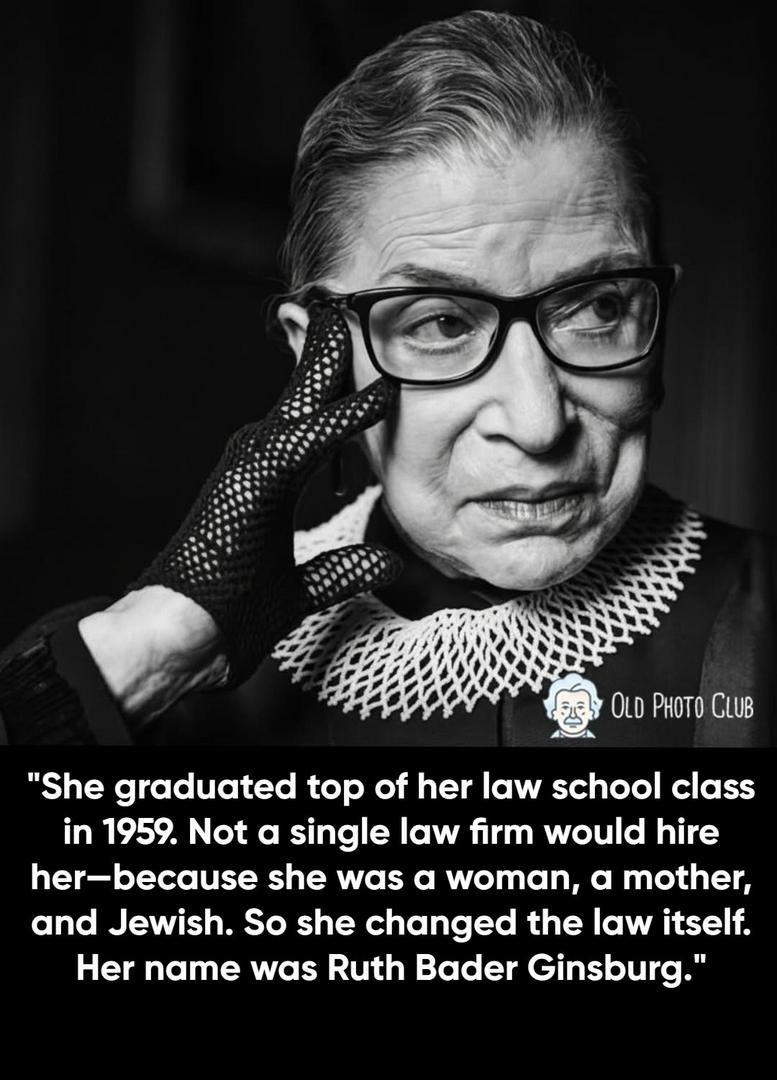
She graduated top of her law school class in 1959. Not a single law firm would hire her—because she was a woman, a mother, and Jewish. So she changed the law itself. Her name was Ruth Bader Ginsburg. And gender equality wasn't just an opinion for her. It was a mission. The Mother Who Never Got Her Chance Joan Ruth Bader was born on March 15, 1933, in Brooklyn, New York, to a working-class Jewish family. Her mother, Celia, was brilliant—but never had the chance to attend college. The family could only afford to send her brother. Celia worked in a garment factory and saved every penny she could for Ruth's education. She died of cancer the day before Ruth's high school graduation. Ruth never forgot that her mother's intelligence had been wasted because she was born female. That women like her mother never got chances simply because of their gender. That memory would fuel everything that came after. The Man Who Saw Her as an Equal Ruth attended Cornell University, where she met Martin Ginsburg—Marty—a chemistry major who would become her husband and the love of her life. Marty did something unusual for men in the 1950s: He saw Ruth as his intellectual equal. He encouraged her ambitions. He believed in her brilliance. They married in 1954. Ruth was 21 years old. When Marty was drafted into the Army, they moved to Oklahoma. Ruth took a job at the Social Security Administration. When her supervisors discovered she was pregnant, they demoted her—standard practice in the 1950s. Pregnant women were assumed to be unreliable, incapable of working, better off at home. Ruth was furious. But there was no law protecting her. Pregnancy discrimination was perfectly legal. She filed the injustice away in her memory. Harvard: Justify Your Existence Ruth enrolled at Harvard Law School—one of only nine women in a class of over 500 men. The Dean of Harvard Law School held a dinner for the female students and asked each of them to justify taking a spot that could have gone to a man. Ruth
2025-11-17

DMG! Red Fury
Women and men aren't equal. They have never have been, they never will be. Nor should we strive to be. It's our differences that make us great.
11-24
Loveland, CO
Reply(105)
90

kaylee
She was not stupid.She was educated she knew alot.she was a smart woman she didn't want to retire she loved her work.she wasn't a loser either.men didn't like her because they were scared of a well educated woman.
.
🙏
11-24
Reply(12)
71

Anabelle
Ruth tarnished her legacy by not retiring before she died. Instead of having a voice in who replaced her, someone who had similar ideals, we got Amy. Ruth, like every other powerful person, didn't want to give it up.
11-19
Bowling Green, VA
Reply(16)
37

Eugene Elar
then she took an appointment to SCOTUS simply because she was female with no experience and was a lousy judge
11-17
East Peoria, IL
Reply(11)
29

Linda Ann Alvarez
Such a Brilliant and Remarkable woman in SO many ways. She’s dearly missed💕🥰🙏🏼
11-17
Riverside, CA
Reply(2)
32

Michelle Wilson
and because of her we are having to pay the price of her stupidity since then. she's a wretched old screwed up woman. and for the life of me I can never figure out this nut was ever popular?? 😉
11-17
Forest City, NC
Reply(11)
23

cha'go jim
Ruth Ginsburg was 90% exceptional, a tremendous force in today's world. The 10% I disagree with was entirely normal—it’s natural for any great person to have flaws. The notion that men or others disliked her for certain reasons is incorrect. The real reason people opposed her was because she was intelligent enough to overrule and expose their intentions. It doesn’t matter if you’re a man, woman, or gay—those in power want to maintain their dominance, their elite status, and suppress opposition. The truth is, the distorted story is that people dislike her; the reality is that the ruling class fears anyone who can challenge their authority, because they remain hidden and in control.
11-25
Pauma Valley, CA
Reply(7)
24

NotYoMama
RGB will never be forgotten!
11-24
Reply(3)
24

Lawrence Herrera
She was the strength in the Supreme Court judges, the crooked criminals are trumps pathetic worthless judges, no comparison to RUTH!!! They will be put in prison for the first time in American history, a traitor tyrant wana be president , his cabinet of clowns and his criminal Supreme Court crooked judges!!
11-28
Los Angeles, CA
Reply(5)
22

Johnny Robinson
Ruth Bader Ginsburg was a warrior,
a champion, & a pioneer. 💕
11-27
Lithonia, GA
Reply
22
More comments ...
write a comment...