1/1

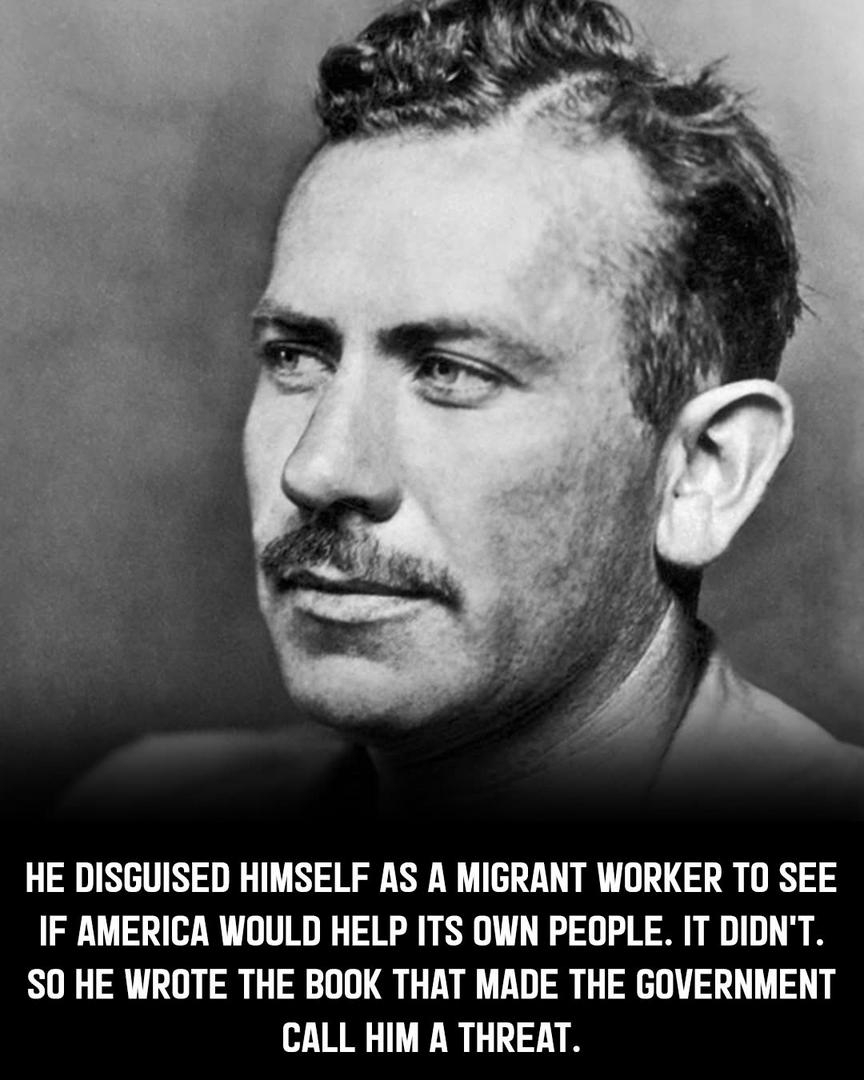
He disguised himself as a migrant worker to see if America would help its own people. It didn't. So he wrote the book that made the government call him a threat. The Great Depression had turned America into a graveyard of dreams. Dust storms buried entire farms in Oklahoma, Kansas, Texas. Families packed everything they owned into broken-down trucks and headed west to California, chasing rumors of work, of food, of survival. They called them "Okies." Newspapers called them dirty. Politicians called them criminals. Growers called them cheap labor. Nobody called them Americans. John Steinbeck was already a successful writer living comfortably in California when he started hearing the stories. Thousands of families living in ditches. Children dying of malnutrition. Workers paid pennies to pick fruit until their hands bled. He could have written about it from a distance. Interviewed a few people. Done some research. Written a nice, safe article. Instead, he did something crazy. He disguised himself as one of them. Steinbeck borrowed a battered old car, put on worn-out clothes, and drove into the San Joaquin Valley. He didn't tell people who he was. No notebooks in sight. No camera. No press credentials. Just another desperate man looking for work. For weeks, he lived in the migrant camps. He slept in tents that leaked when it rained. He ate whatever scraps he could find. He stood in lines with hundreds of men, all begging for jobs that paid five cents an hour—if they were lucky. He watched mothers sing lullabies to hungry children beside dying campfires. He saw families torn apart when only one person could get work. He witnessed men—farmers who had owned land, who had built lives with their hands—reduced to begging for food their children were too weak to eat. "You have no idea how terrifying hunger sounds when it cries," he wrote in his secret notebook. "It changes the shape of a man's face." Every night, by lantern light, Steinbeck filled pages with what he'd seen.
2025-11-23

Ardra Caine
this is the America Trump is creating. maga are traitors.
11-23
Cumberland, MD
Reply(47)
99

Edwin White
If he's a migrant then he's not an American.
11-23
Montoursville, PA
Reply(37)
24

the hollerbeef
"Those who don't remember the past are condemned to repeat it"
11-24
Houston, TX
Reply(8)
56

Victoria Jaffier
We are all human and Americans. Why are you guys concentrating on who is a democrat or a republican? Let's do God's will and show love. We will never agree on everything, but if we remember kindness and love as our deciding factors maybe we can all live in a better place.
11-24
Brooklyn, NY
Reply(9)
56

Morgan
The Grapes of Wrath was one Steinbeck's finest novels , and only touched on the harsh reality of that time.
11-23
Centralia, WA
Reply
58

Judie Woods
I thought everyone read "The Grapes of Wrath" in high school. Judging by the ignorance about American migrant workers, it is obvious they did not do their required reading, or the book was not assigned. Or possibly they are unable to read.
11-24
Lincoln, DE
Reply(13)
49

Mr Hyde
The point is, the character of a nation is determined by how it treats not only it's own people, but how it treats those around us. I would say we have failed that.
11-24
Melrose, TN
Reply
37

Terrance Stuart
I grew up in that Valley. It had a plantation flair to it. As a child I picked cotton. I pruned vines. I worked in a grocery store owned by hard working Okies. My childhood was enriched by the cultural experience of hard working Mexicans and whites building the most successful agricultural venture of the modern world has ever seen.
11-23
Coraopolis, PA
Reply(1)
32

Charlotte Langston
Beyond people calling each other names, is the truth of the depression. Americans had no food and treated those in need with little charity or compassion. My parents were children then and times for the hard for everyone. They didn’t have much. We don’t want that again🤔🤔🤔.
11-24
Lake Charles, LA
Reply(3)
27

Frederick Webber

11-25
Milwaukee, WI
Reply(9)
23
More comments ...
write a comment...