1/1

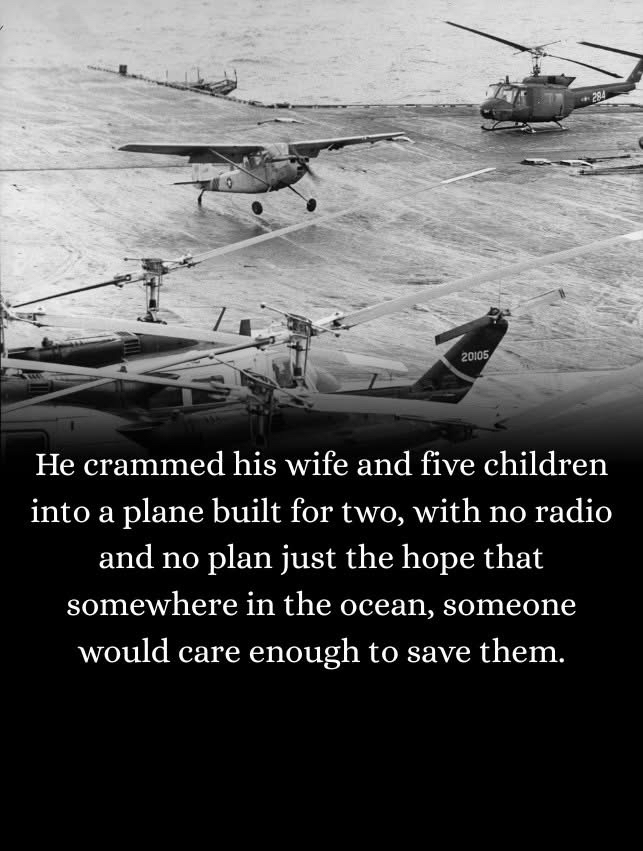
He crammed his wife and five children into a plane built for two, with no radio and no plan—just the hope that somewhere in the ocean, someone would care enough to save them.On the morning of April 29, 1975, South Vietnamese Air Force Major Buang-Ly woke up knowing his country had hours left. He was stationed on Con Son Island, fifty miles off the southern coast—a prison island with a small airfield. North Vietnamese forces were closing in. The prison guards were abandoning their posts. If his family stayed, there would be no mercy for a military officer.On the tarmac sat a Cessna O-1 Bird Dog, a tiny two-seat reconnaissance plane. Major Buang-Ly looked at his wife. He looked at their five children—the youngest just fourteen months old, the oldest six. Then he made his decision.He helped them all squeeze into the backseat and storage area. He hot-wired the engine. As the overloaded plane lifted off, enemy ground fire zipped past them. He banked east toward open ocean with no destination, no radio, and only one desperate hope: that the American fleet was still out there somewhere.After thirty minutes over the South China Sea, he spotted helicopters flying in formation. He followed them straight to the USS Midway.The aircraft carrier's flight deck was chaos. Operation Frequent Wind—the largest helicopter evacuation in American military history.Then spotters noticed something different. A fixed-wing Cessna with South Vietnamese markings, circling with its landing lights on.Captain Lawrence Chambers had commanded the Midway for barely five weeks. He was the first African American to command a U.S. Navy aircraft carrier. Now he faced a decision that could end his career.The admiral aboard ordered Chambers to make the pilot ditch in the ocean. Rescue boats would pick up survivors.
2025-12-12

William Schwartz
The rest of the story.
12-15
Smyrna, GA
Reply(17)
141

Bob Jorgensen
I was there at that time. I was on board the uss Warden DLG18. I was in the OS division. I remember hearing it over the radio as it happened. we were the Midways escorted.
12-21
Santa Cruz, CA
Reply(4)
40
Pete Flynn
People cheer this guy and vilifiy refugees doing the same damn thing today. Seems hypocritical. Many of the people showing up here face situations as bad if not worse and we tell them "go home and fix your country."Why didn't anybody that to this guy?
12-23
Bluefield, VA
Reply(29)
26

Jerry Chaney
April 1975 token gulf. Was there onboard Midway when it happened. Was probably still classified as CVA then.
12-12
Hobbs, NM
Reply(9)
33

JOHN WESTLEY
and, where is the rest of the story
12-12
Fishkill, NY
Reply(8)
24

Javier R Pereda Pereda
A wise decision on the part of the Viet namese soldier to rescue his family and himself.It takes a great courage and a well plan as he risked it all.I would have done the same .🥰🙏🌸💕
12-13
New York City, NY
Reply
25
Sailor 41
I was there when this happened, he dropped a note attached to a wrench. The note was brought to Captain Chambers and a message was to “clear the deck” throwing several bubble helicopters off the fantail. We went to flank speed and then they landed. They were surrounded by the flight deck crew so the small aircraft wouldn’t blow off the deck. We then reduced speed. The USS MIDWAY museum has a copy of the plane in the hangar bay, the original is in the Air and Space Museum in Washington DC. It was a long time ago.
02-01
Cape May CH, NJ
Reply(3)
19
Joe Smolik
Not only would be have killed him and his family they would’ve tortured them. It is thinking was it is better to die free and quick than long slow painful death for him and his family.
12-23
Cape Coral, FL
Reply
18

Guest
He managed to drop a message onto the flight deck of the Midway explaining who he was and the situation he was in. The order was given to clear the flight deck by pushing the helos off the flight deck so that the bird dog aircraft could land. I believe that the plane is on display in a museum back east.
12-13
Reply(1)
17

Tre'
there was no other order to give The admiral couldn't risk letting a plane land and blowing up the ship👍🙏
12-12
Buffalo, NY
Reply(4)
14
More comments ...
write a comment...