1/1

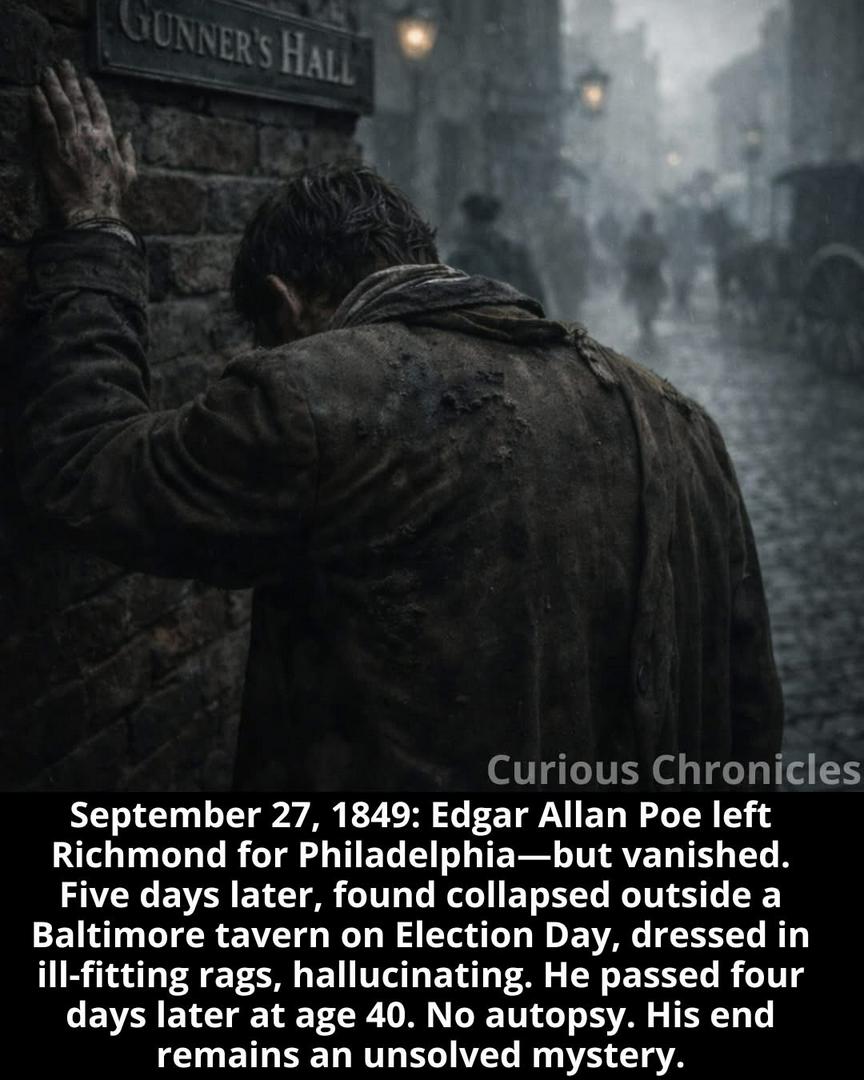
On September 27, 1849, Edgar Allan Poe departed Richmond for Philadelphia, then New York—but he never arrived. Five days vanished into mystery. On October 3, Baltimore's Election Day, a compositor named Joseph W. Walker found Poe collapsed outside Gunner's Hall tavern. He was barely conscious, dressed in ill-fitting rags—a shocking sight for a man famous for impeccable black attire. Rushed to Washington College Hospital, Poe drifted through hallucinations for four days, repeatedly calling out for someone named "Reynolds." He passed on October 7 at age 40. Dr. John J. Moran recorded the cause as "congestion of the brain," and no autopsy was performed. Speculation has run wild ever since. Some suggest substance issues, though witnesses claimed he'd been sober. Others argue he was a victim of "cooping," taken and forced to vote multiple times in disguise. Illness or even foul play have been proposed. The truth of Poe's final days remains as haunting and opaque as his gothic fiction. The man who wrote endlessly about inexplicable ends ultimately became the subject of his own ultimate unsolved story. #fblifestyle
Baltimore, Maryland • 2026-01-02

White Tiger
I have the original first copy of one of his books.
01-30
Frederick, MD
Reply
2
More comments ...
write a comment...