1/1

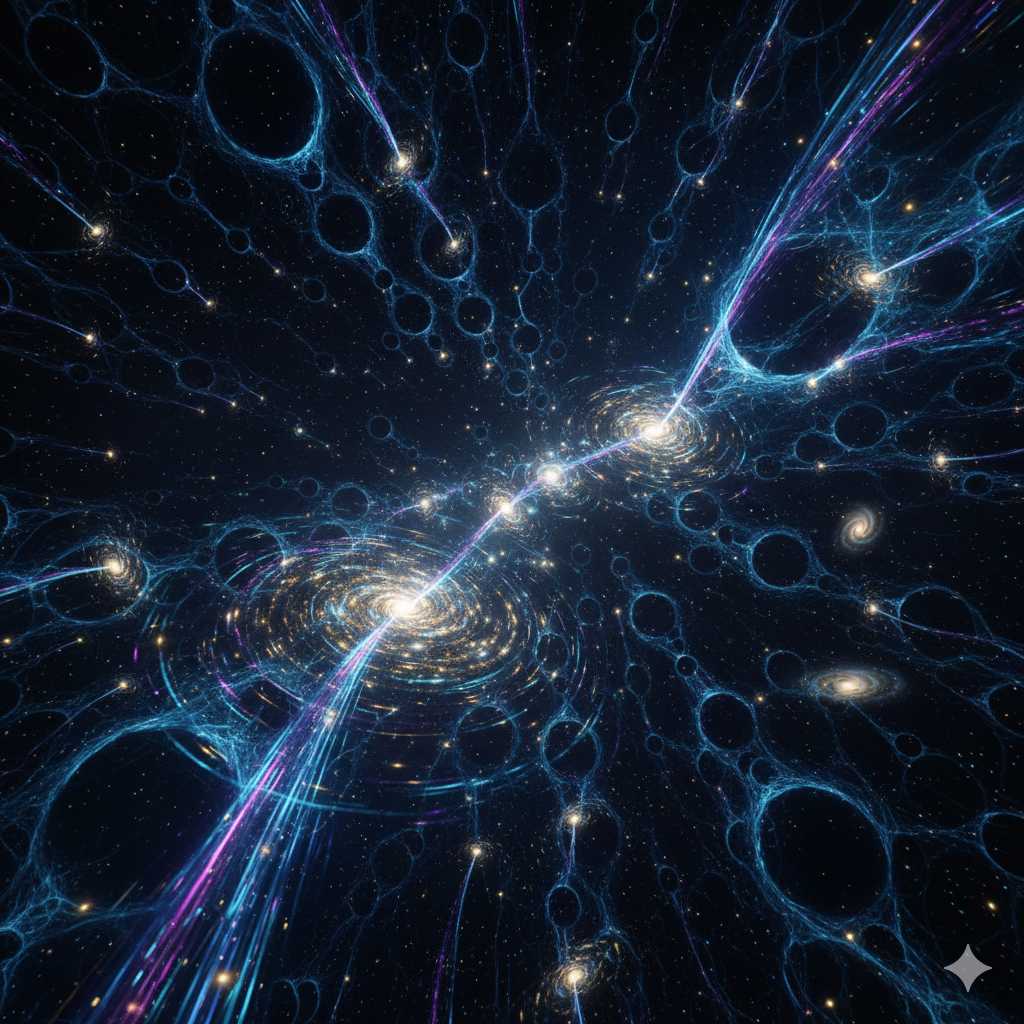
When I look at everything we know about the universe as of 2026, what I see isn’t random chaos — it’s a vast, intricate structure called the Cosmic Web. To me, it feels less like a scattered collection of galaxies and more like a living network — something that mirrors the architecture of a massive, cosmic brain. On the largest scales, galaxies aren’t floating alone in space; they’re linked together, strung like illuminated pearls along colossal filaments made of dark matter and hydrogen gas. These filaments stretch for billions of light-years, guiding matter into intersections called nodes — places where thousands of galaxies cluster together. When I look at the data or the visual maps, it’s almost uncanny how much this resembles the interconnected neurons in our own brains. It makes me wonder if the same laws that govern complexity and information in our minds also shape the structure of the entire cosmos.When you zoom out even further, the universe takes on another form — something like an infinite sponge or a web of bubbles. The filaments of the Cosmic Web wrap around immense, nearly empty pockets of space known as cosmic voids. These voids make up most of the universe’s volume, the “empty” space between the threads of the web. Yet even with all that emptiness, the overall geometry of the universe stays surprisingly flat. Measurements from the past couple of years show that the cosmos holds a perfect balance — a critical density that keeps space Euclidean, meaning parallel lines stay parallel forever. And here’s what fascinates me most: new findings suggest that these gigantic filaments aren’t still. They actually rotate. That means the universe itself might not be some static void but a dynamic, spinning system — a vast, coordinated dance of matter and motion. In that sense, everything is connected, moving together in one enormous flow, maintaining structure and light against the infinite backdrop of darkness.
2026-01-02
write a comment...