1/1

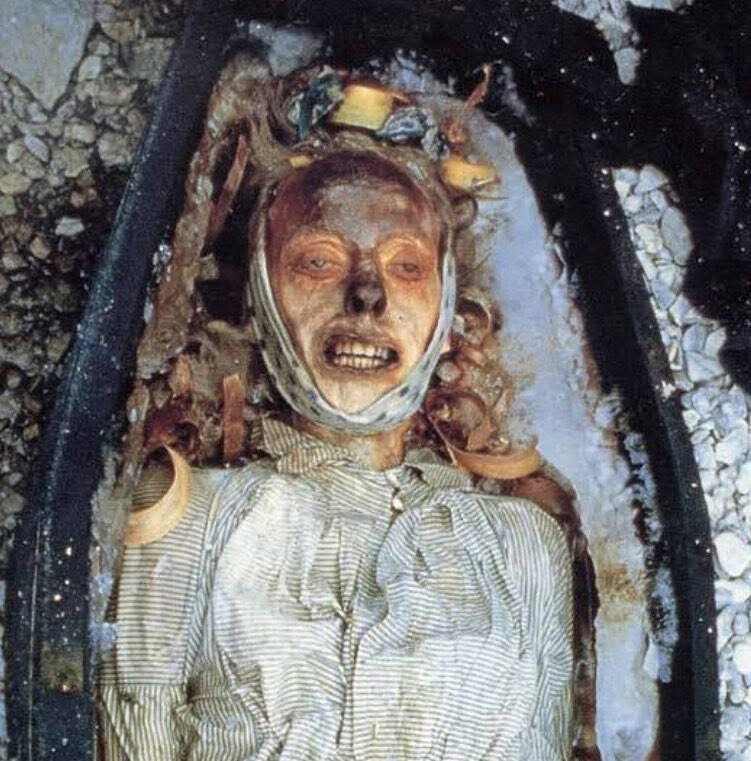
This photograph shows the frozen corpse of sailor John Torrington. Born in 1815, Torrington was a member of the ill-fated Franklin Expedition, which embarked on a voyage in 1845 with the goal of navigating the Northwest Passage - a route connecting the Atlantic and Pacific Oceans through the Arctic Archipelago. The Franklin Expedition, which was led by Sir John Franklin, was one of the most ambitious Arctic explorations of the 19th century. It set out with two ships, HMS Erebus and HMS Terror, and a crew of 129 men, including Torrington, who served as a Royal Marine. The expedition’s objective was to chart the Northwest Passage. Tragically, the expedition was eventually stranded in the icy waters of the Arctic, and all members of the crew died. In 1984, researchers discovered the remains of Torrington, along with those of other crew members, in a grave site on King William Island. The remains were remarkably well-preserved due to the extreme cold and the permafrost conditions of the Arctic. The examination of Torrington’s body provided significant insights into the conditions faced by the expedition. Torrington was found to have suffered from tuberculosis and malnutrition, which, combined with the harsh Arctic environment, contributed to his death.
2026-01-13

jfz69
And lead poisoning from cans of food they ate
01-13
Hoffman Estates, IL
Reply(48)
64

The Joker
Is that Madonna
01-15
Tomball, TX
Reply(19)
49

James Donegan
if everybody died who buried the last guy????🤔
01-13
Conyers, GA
Reply(11)
25

Hay TuAwl
I can't believe I just wasted 10 minutes of my life reading all these comments. good lord, I need a hobby.
01-15
Rapid City, SD
Reply(5)
25

Charlotte Herrin
The pic shown is of a deceased woman in a fancy blouse and dress.
01-14
Cottondale, AL
Reply(9)
21

keto grannie never too late
picture looks like a woman
01-13
Roanoke, VA
Reply(4)
23

William Tecumseh Sherman
Looks like The lion from the Wizard of Oz 👍🏻
01-15
Levittown, NY
Reply(6)
20

Zero Myth
I must be looking at the wrong picture. The picture looks like a dead woman.
01-17
Reply(14)
14

Michael Bennett
I thought that was Pelosi
01-16
Merritt Island, FL
Reply(3)
20

MyNameIsSunshine
with long hair?
01-15
Acton, MA
Reply(16)
10
More comments ...
write a comment...