1/1

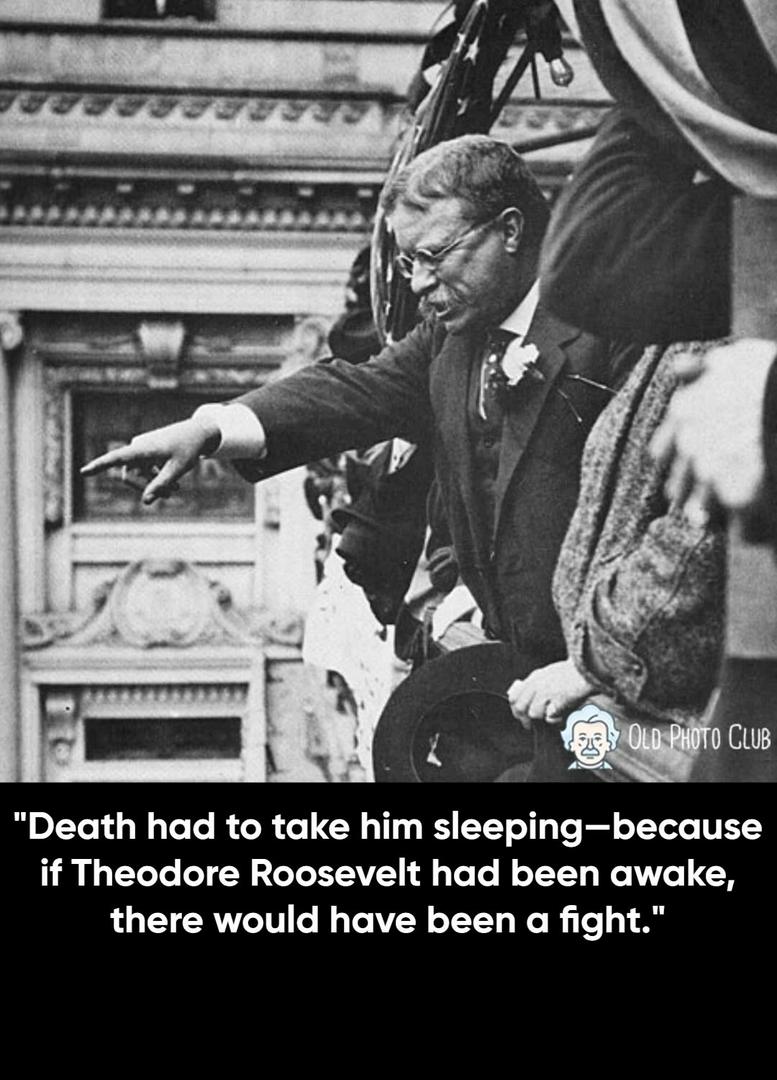
Death had to take him sleeping—because if Theodore Roosevelt had been awake, there would have been a fight. On January 6, 1919, Theodore Roosevelt died quietly in his sleep at his home on Sagamore Hill. He was sixty years old. The news stunned America. Not because death had come—Roosevelt had been ill for months. But because of how it came. Quietly. Without struggle. Without his famous defiance. This was the man who charged up Kettle Hill in Cuba under Spanish gunfire and became a national hero overnight. The man who, when shot in the chest by an assassin in 1912, still delivered his speech for ninety minutes before going to the hospital. "It takes more than that to kill a Bull Moose," he told the crowd, blood soaking his shirt. The man who, after losing his bid for a third presidential term, traveled to the Amazon to explore a river so dangerous it was called the River of Doubt. He nearly died there too—from starvation, malaria, and a leg wound that became infected. He lost fifty pounds and never fully recovered. But he came home. He always came home. Roosevelt's life had been a series of battles won through sheer force of will. As a child, he was frail and asthmatic. His father told him he would need to make his body match his mind. So he did. He lifted weights, boxed, rode horses, climbed mountains. He transformed himself into the barrel-chested icon America came to know. As a young man, he lost his mother and his wife on the same day. He retreated to the Dakota Badlands to ranch cattle and grieve. He returned two years later, remarried, and threw himself into politics with renewed ferocity. As President, he battled corporate monopolies, established national parks, and expanded American power across the globe. He was the youngest man ever to hold the office. He governed with the same energy he brought to everything else.
2026-01-16

Bruce Bryant
He was allot like Trump, did what had to be done.👍🙏🇺🇸
01-17
Ocala, FL
Reply(23)
38

abigale444
Trump couldn’t hold a candle to this American hero.
It’s well documented how dangerous Trump and his minions are to America , but what can be done? Those who say use your vote might have a point but there’s an3 yrs!!! He can do a lot more damage in that time. Impeachment leaves us with Vance who is smarter than Trump and more evil, Johnson has no value at all.
How did our forefathers not provide options to help with these type of problems?
To me, Harris may not have been attractive to some but i doubt she’d be as corr, devisive, or disregarding of human kind
01-17
Lady Lake, FL
Reply(9)
21

Billy Deavers
How did this article fall on Trump ? Unbelievable the hate for him ..Go get help before it’s too late .
01-17
Spotsylvania, VA
Reply(9)
22

Jim Kaighn
Hell no!! Roosevelt was a true American hero! TRUMP is a true Fascist ZERO!!!
01-17
Williamstown, NJ
Reply
23
Michael Kinsey
Dispite the general beliefs of the day he was and is still one of my favorite presidents.
01-17
Dallas, TX
Reply
16

Gerard Kowalski
One of our better presidents!👍
01-17
Erie, PA
Reply
12

Robert Caruolo
He had balls and a spine to go with it
01-18
Reply
7

Brian Stewart
THIS was a REAL MAN, NOT this CRIMINAL currently RUINING the United States and the WORLD, as we speak!!!
01-20
Jeremiah, KY
Reply
6
More comments ...
write a comment...