1/1

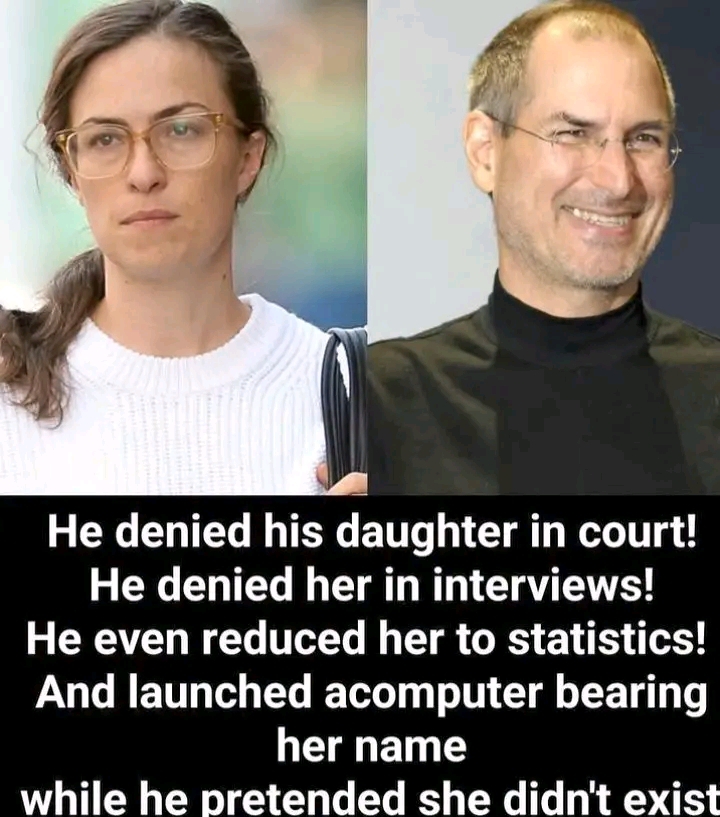
Steve Jobs named a computer after his daughter — while denying she even existed. Silicon Valley worships disruption. It praises the visionaries who bend reality, who break down what came before so something new and dazzling can rise. But stories of what gets broken in the process? Those don’t make the keynote slides. May 17, 1978: a baby girl is born on a commune just outside Portland, Oregon. Her mother is Chrisann Brennan. Her name? Lisa. The father — 23-year-old Steve Jobs — doesn’t show up to meet her until three days later. Not because he forgot, but because he didn’t yet recognize the cost of becoming a dad. Jobs, the brilliant co-founder of Apple Computer, was made for disruption. But fatherhood? Not so much. He publicly denied Lisa was his daughter. When a court ordered a DNA test, the result came back: a 94.1% probability he was her father. His response? “Twenty-eight percent of the male population of the United States could be the father,” he told TIME. Imagine being that child. Imagine knowing your DNA is your bond, but being told your existence is statistical noise. The court didn’t believe him. Jobs was officially declared Lisa’s father and ordered to pay $385 a month — which later rose to $500 after Apple went public in 1980. When you’re building a multi-billion-dollar company, $500 a month is not charity — but it’s not what a child deserves either. Meanwhile, Apple was working on a revolutionary new computer. One with a graphical interface, a mouse, and innovation that felt like tomorrow. The system needed a name. They called it Lisa. Officially, “Lisa” stood for Local Integrated Software Architecture. But years later, Jobs confessed to his biographer, Walter Isaacson: “Obviously, it was named for my daughter.” Think about that. The same man who denied her in court named a computer after her — not as a tribute, but buried in tech jargon. In 1983, Apple launched that computer for nearly $10,000 — more than many cars at the time. The product failed.
2026-01-25

Teofilo Babar Jr.
SHE CERTAINLY LOOKS LIKE HIM.
01-26
Lake Forest, CA
Reply(1)
8

deborah mccloud
Well, I'm sure 💰 🤑 💸 💲 is not one of her worries.......
01-25
East Chicago, IN
Reply(4)
4

LuceDe
This guy had a pretty significant sadistic streak
01-27
State College, PA
Reply(2)
5

Leslie Waters
He was an awful person.
01-28
Seminole, FL
Reply(1)
4

Kelly Blanton
she looks just like him.
01-26
Sebring, FL
Reply
4

Michelle Lewis
Wow pancreatic cancer really took him away didn’t it? I guess what goes around comes around
01-27
Eddystone, PA
Reply
3

bob
It wasn’t after his daughter, the acronym just happened to fit that and he took it.
01-27
Devils Lake, ND
Reply
2

smartwerker
oh well, men do many things and complete many hardships in order to keep a relationship with women that feel that all the attention should go to them.
all it took is his current wife to be jealous over the fact that they had no kids yet
01-26
Manteca, CA
Reply(1)
1

It takes a Karen to run L.A.
This is why certain activities are for marriage. Somebody who has made it down the aisle is often more likely to have thought out these things and feel a sense of responsibility. ⭐️Job’s wife was a MBA student at Stanford and he chased her down to ask her out after she attended a lecture he gave there. I believe they had 3 children together. Go out and buy your casual
01-27
Stockton, CA
Reply
Tom Sisson
Yep, that’s Steve Jobs. Every one is a statistic. No one knows what they want. He will tell them what they want. And he will tell everyone what they’re worth yep, that Steve Jobs.
01-31
Roseburg, OR
Reply
More comments ...
write a comment...