1/1
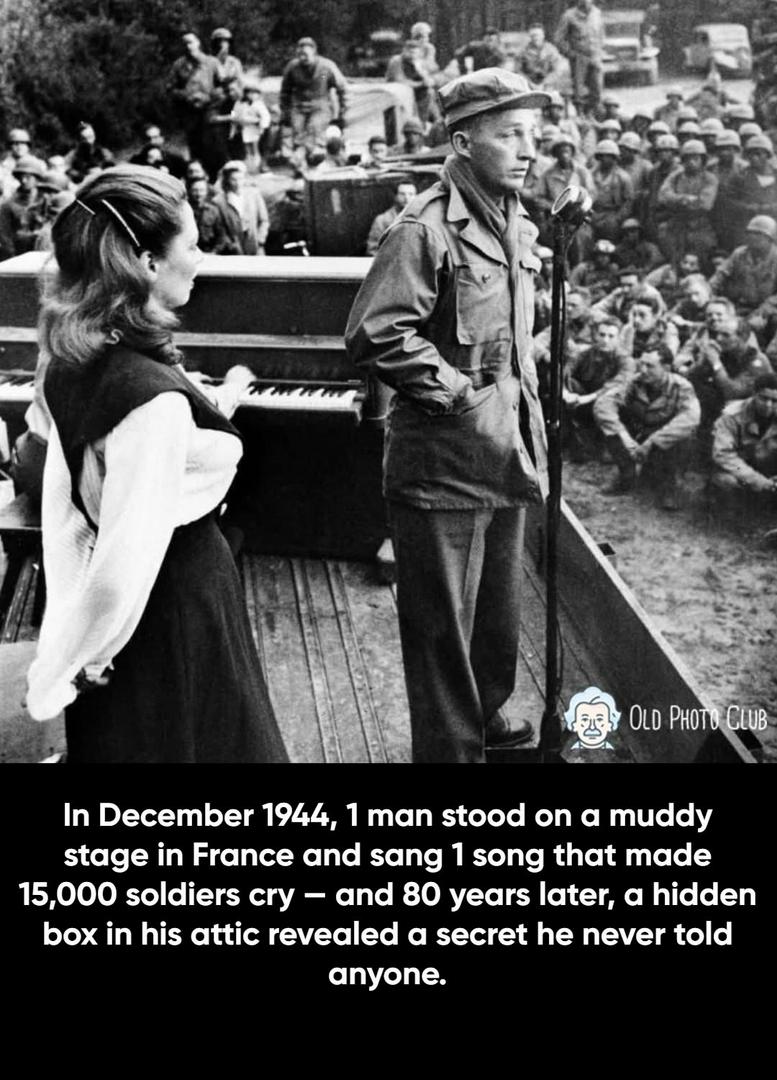
Bing Crosby was known for his smooth voice and easygoing charm. He was the kind of man who made everything look effortless. But there was one afternoon during World War II that tested him more than any movie, any concert, or any moment in his long career. It was December 1944. The war in Europe was at its darkest point. Crosby had volunteered to tour the front lines with a USO crew, performing for American and British troops in open fields across France. He did not have to be there. He chose to be there. That day, he stood on a makeshift wooden stage in a muddy field in northern France. The air was cold and heavy with the smell of damp wool and woodsmoke. In front of him sat roughly 15,000 soldiers. Many of them were barely out of their teenage years. They had been living under the constant shadow of death for weeks. Within days, many of them would face the brutal fighting of the Battle of the Bulge. Some would never come home. The show had started with lighthearted jokes and upbeat songs. Dinah Shore and The Andrews Sisters had performed alongside Bing, doing everything they could to give these young men a few hours of joy. The crowd laughed. They cheered. For a brief moment, the war seemed far away. Then came the final song. As the band played the opening notes of "White Christmas," something shifted. A deep silence fell over the entire field. Fifteen thousand soldiers went quiet at once. Then Bing saw it. Row after row of young faces, covered in mud, beginning to cry. The song reminded them of everything they had left behind. Their mothers. Their wives. Their childhood homes covered in snow. The Christmas mornings they were not sure they would ever see again.
2026-02-16

Edd Labenz
He did an Amazing job Entertaining "Thousands of Troops", during the Battle of the Bulge, that many of those same Troops survived. But for those of you who Never Served, it was the USO and great Entertainers like Cosby, Bob Hope, Dinah Shore, and countless many more, who gave up their Holidays to make sure the Troops got a little taste of entertainment, which during War time, for many, was the last thing they remembered and "Never" forgot! While some criticize their personal family life, they knew, but made their own sacrifices to make sure the Troops had some Special Moments in a nasty War. God Bless all of them for :Giving of themselves".
02-17
Timonium, MD
Reply(1)
24

Faye Jarmolowicz
💙🇺🇸💙 God Bless Our Veterans 🙏🏼💙🇺🇸💙
02-16
Erie, PA
Reply
21

BV B
USO entertaining the troops during WWII, was the highlight of many soldiers. It gave them a little taste of home for a few minutes. My Dad told me, for a lot of soldiers that was the last piece of home they had. The cemeteries in Europe I pray anyone touring Europe please show respects.
02-16
Annapolis, MD
Reply
19

LaNita Darden
punishment for children was very different in his day. I was raised with a belt for misbehaving. don't judge his too harshly
02-17
Washington, DC
Reply(2)
16
Hadron
While he was a very accomplished singer, according to his children's accounts, he was not a good father.
02-16
Washington, DC
Reply(3)
12
Linda Diehl
What does any of this have to do with a box in his attic?
02-16
Erie, PA
Reply(2)
12
BV B
If visiting the Ocracoke Island at Outer Banks, please pay respects and honor to the small piece of Britain, where a final resting place for British Sailors.
02-16
Annapolis, MD
Reply
10

Fran Vanderweyst
what a song to play too soldiers who want to be home for Christmas
very poor taste
02-16
Bloomington, MN
Reply(1)
9

Tom
😲Two days after arriving in Vietnam I was assigned to a working party to set up the sound system for the Bob Hope show. I knew just how important this show was for the morale of our Marines when the Commanding General of all the Marines in country came by to check out my work. I was in country for two Christmases and did not attend any of the USO shows because I thought that I was the senior NCO and it was important to me to take care of my junior marines. The only contact I had with the Red Cross was they all ways had coffee and books. I have been a reader since second grade and still am. Books were a little lift in my morale because they could transport me to the stars or a fur trapping in the Rockies with the words that were written. The USO had a soda fountain in Da Nang. Since I had allotted most of my pay to my wife I didn’t spend much time with the USO.
02-20
Jacksonville, FL
Reply(3)
7
Mark Thompson
Bing was actually not nice and a poor father. Research it. 🤔
02-20
Follansbee, WV
Reply(3)
5
More comments ...
write a comment...