1/1

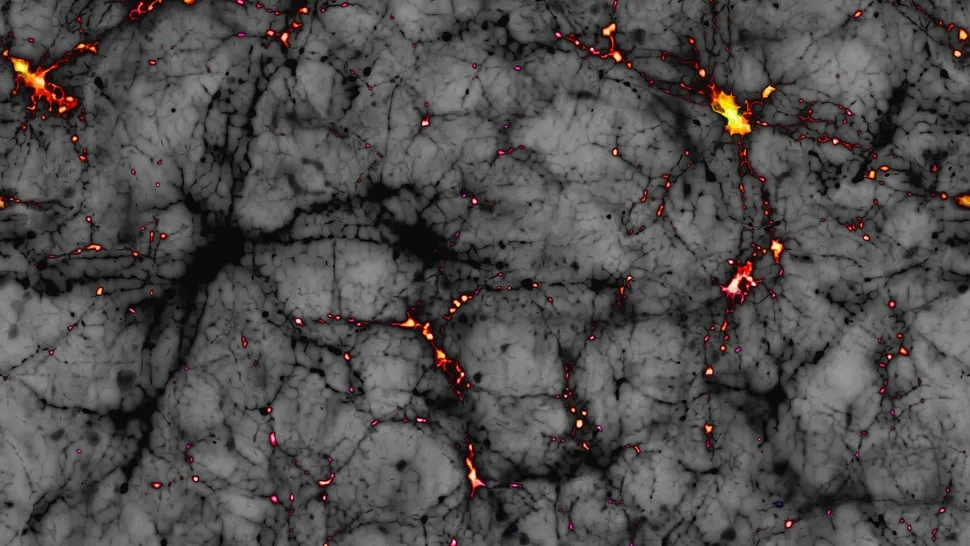
What Is Dark Matter? Discovering the Invisible Universe Dark matter is a mysterious type of matter that cannot be seen because it does not emit, absorb, or reflect light. Scientists know it exists because of its gravitational effects. Stars in galaxies orbit far too fast to be held together by visible matter alone. According to the laws of Isaac Newton and Albert Einstein, galaxies should fly apart, but they remain stable. The invisible mass providing this gravity is called dark matter. Evidence comes from multiple observations. Vera Rubin found in the 1970s that stars at the edges of galaxies move as fast as those near the center. Gravitational lensing shows light bending more than expected. Galaxy cluster motions also indicate unseen mass. Precise measurements of the cosmic microwave background by Planck show the universe is about 68% dark energy, 27% dark matter, and 5% ordinary matter, highlighting how dark matter outweighs all visible matter by more than five times. Interestingly, some studies suggest dark matter may have formed tiny clumps smaller than the Earth, meaning small invisible structures could exist throughout the universe. Scientists propose several theories. WIMPs, or weakly interacting massive particles, would have mass and rarely interact with normal matter. Axions are extremely light particles forming a field across space. Sterile neutrinos, heavier relatives of normal neutrinos, could account for dark matter. Some suggest primordial black holes or a hidden “dark sector” of unknown particles. Alternative theories like MOND propose gravity behaves differently at low accelerations instead of requiring invisible matter. Despite decades of searching, no direct detection has occurred. Dark matter remains a fundamental mystery, quietly shaping galaxies, clusters, and the universe itself, influencing its growth, structure, and evolution over billions of years. #DarkMatter #Science #SpaceWonder #UnknownScience #UnknownScience
2026-02-19

DOMicrom9
I guess it doesn’t matter, then.
02-20
Reply
1
More comments ...
write a comment...