1/1

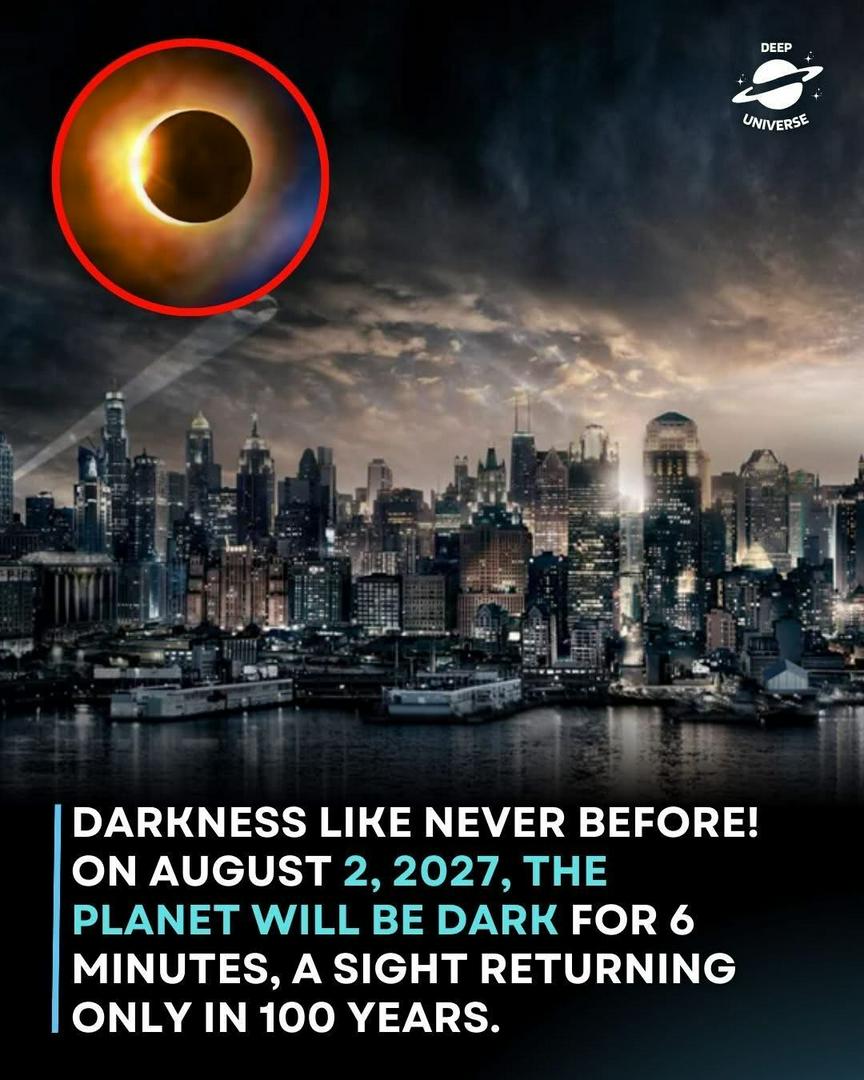
For a fleeting six minutes, day will vanish into night, and the world will hold its breath. On August 2, 2027, the Sun, Moon, and Earth will align in a perfect cosmic dance. It is a quiet shock to realise that such moments of total darkness are so rare — a spectacle that will not grace our skies again for a century. During a total solar eclipse, the Moon completely blocks the Sun, casting a shadow that races across Earth. The corona, the Sun’s outer atmosphere, will shimmer like delicate silver fire around the dark disc. Birds will pause, temperatures will drop, and even the air seems to change, as if nature itself senses the extraordinary. It is not just a visual phenomenon, but an event that reminds us of our fragile place in the cosmos. Scientists study these eclipses to understand the Sun’s mysterious outer layers. Subtle patterns in the corona reveal magnetic fields and plasma flows that cannot be observed any other way. Observing such a rare alignment allows humanity a fleeting glimpse into forces that shape our solar system, hidden most of the time from our eyes. For those who witness it, the eclipse becomes more than science. It is solemn, intimate, and almost spiritual. Standing beneath the shadow of the Moon, one cannot help but feel the vastness above, the precision of celestial mechanics, and the smallness of our daily concerns. The darkness will pass, light will return, and life will resume as if nothing changed. Yet for those six minutes, the world will share a rare moment of unity under the sky, leaving behind a lingering question: how many wonders of the universe wait silently for us to notice them? #DeepUniverse #SolarEclipse2027 #CelestialEvent #TotalEclipse #Astronomy #SkyPhenomena #CosmicWonder #fblifestyle
2026-02-22

Kalu
So what? … I walked behind JB Pritzker for 8 minutes one day.. the gravitational pull was wondrous
02-23
Hanford, CA
Reply
4

Elmer_fudd
And when the sunlight come shining after there will be multiple extraterrestrial species in crafts above to show humanity we are one !
02-23
Garner, NC
Reply
2

A G
My Birthday!
02-25
Fenton, MI
Reply
1

BoZillA The Great
the lowest tide. great for searching the sands. both the gravity of the moon and sun, gives a rare chance for medal detection on the beach.🤔
02-23
Columbus, OH
Reply

Carter Hernandez
While dirty Diana is playing in the background 😜😜😜
02-23
Little Rock, AR
Reply
More comments ...
write a comment...