1/1

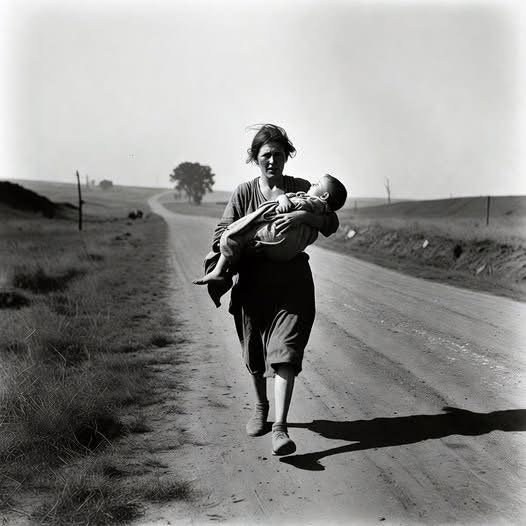
For thirty-one days—from March 3 to April 3, 1926—twenty-seven-year-old Mae Bellamy walked 400 miles carrying her five-year-old son Thomas on her back, walking from dawn to dusk through rain and mud and cold, sleeping in ditches and barns and under bridges at night, begging food from strangers, talking to Thomas the entire way—telling him stories, singing him songs, telling him they were almost there even when they weren't even close—because Thomas had a growth in his throat that was slowly choking him to death and the nearest hospital was 400 miles away and no doctor within 200 miles could remove it and Mae had been told by every doctor she could find that Thomas would die within two months if the growth wasn't removed and Mae had decided that Thomas was not going to die, not while Mae was breathing, not while Mae could still walk, and the only way to save Thomas was to get him to a hospital 400 miles away and Mae was going to carry him there if she had to. Mae had taken Thomas to three doctors in January 1926—doctors in small towns within fifty miles of Mae's home in rural Arkansas—and all three had examined Thomas and all three had said the same thing: the growth in Thomas's throat was too large and too close to his airway to remove safely with the equipment available in their small-town clinics, and Thomas needed surgery at a hospital with proper surgical facilities, and the nearest such hospital was in Memphis, Tennessee, 400 miles away. Mae had no money for train fare. Mae had no automobile. Mae had no way to get to Memphis except to walk, and Mae had no one to help her—Mae's husband had died two years earlier, Mae had no family nearby, Mae had no neighbors who could help—and the doctors had told Mae they were sorry but there was nothing more they could do. Mae left her home on March 3, 1926 Continued story in comments
2026-02-23

Doll Jones
she was a strong and Determined woman her child ment the world to her and nothing was going to stop him from living long as she had breath in her body bless her 🙏
02-23
Batesville, MS
Reply
15

Debra Smith
For the love of a child Moms can move mountains. This is such a Mom. I hope she saved his life because I don’t know what happened half the story is missing.
02-23
Dryden, MI
Reply(1)
14

Susanne Gentile Costigan
That's what moms do…she is one of many unsung heroes for her family. Thomas was born to the right mom. This is a wonderful, inspiring story.
02-23
Ocean Bluff, MA
Reply
11

John Kroeger
now that is a mother's love right there no matter what she said my child is going to live.
02-24
Greenfield, IN
Reply
10

OG Philly Girl
that's a mothers love 💕
02-23
Snell, VA
Reply
10

Mildred Washington
Whether no one help Mae and her ailing son, she did what she had to do. She was determined not to let her son died because she lost so much already. Mae was strong, courageous, and showing consideration toward her son with love and compassion. I believe her son will never forget his loving mom determination and struggles to get him the medical her son needed in life. I am proud of Mae because I am her too. I had a car and have save my daughter life as well. I love to read and hear good stories with God's help for people who will not defeated but become a winner with victory over whatever they are going through in life. Amen. Praying changes situations and circumstances in our midst of storms with challenges along the way. Amen again. 😲👍🙏💕
02-23
Granite City, IL
Reply
9

Jennifer Maghinay
🙏🏼🙏🏼🙏🏼🙏🏼
02-23
Salem, Oregon
Reply
9

Joyce Campbell
A True Mothers Love, for her Children is so Beautiful!
My precious Mother, Raised all five Children, by herself!
She didn’t get a Government Welfare Check or Food Stamps, like a lot of people did!
She worked very hard in the fields for Farmers, Planting & Harvesting & the Farmers Peddled their crops! Never, offered a bite to help us except, to try to sell us ROTTEN BANANAS!
She worked out in the Tobacco Fields, Planting, Hoeing, Suckering, Cutting & Hauling, Hanging & Grading Tobacco for Farmers for, 25 cents an hour!
As my Eldest Brother & I, got a little older, we worked too, for 25 cents an hour to help Momma. My Precious Momma, cleaned Rich Peoples houses, Did their Laundry, Ironed their Clothes, Bed Sheets, even, their handkerchiefs & underwear, 50cents an hour!
She worked, til her hands poured blood & my Momma, could outwork any man in tobacco!
Color of the skin, doesn’t define a person! A MOTHERS love, is a Strong Bond, no man can match
Thank U MOMMA🥰🥰
I- LUV -U-FOREVER🥰🥰
02-24
Bluff City, TN
Reply(1)
8

Joann Mccain
She was one of the legal immigrants who built this nation, lived through hard times that the democrats and leftists want illegal invaders to replace or that they want to die as this woman will never submit to their tyranny and control!
02-24
Auberry, CA
Reply(1)
7
More comments ...
write a comment...