1/1

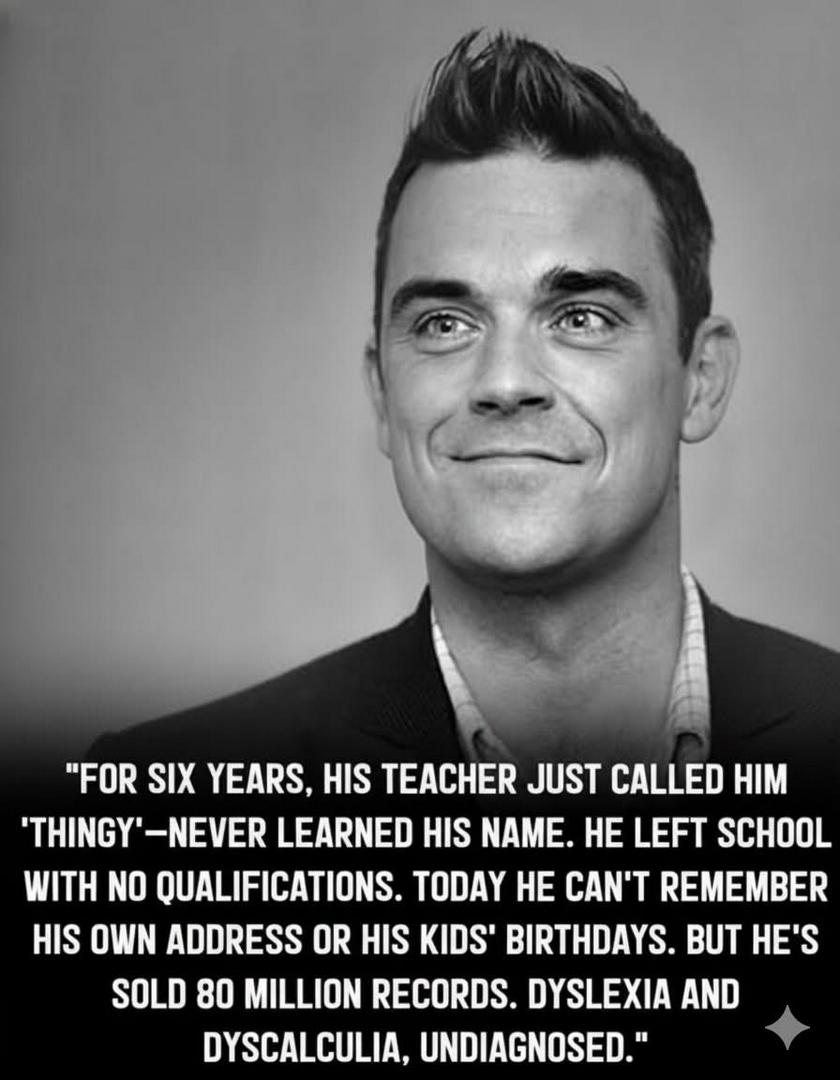
His teacher never learned his name—just called him "thingy" for six years. He failed every exam. Decades later, he can't remember his wife's birthday or his kids' ages. But 80 million people bought his music. A classroom in Stoke-on-Trent. Young Robbie Williams stared at the chalkboard, watching letters rearrange themselves like a puzzle he'd never solve. The teacher droned on. Other kids scribbled notes. Robbie's page stayed blank. Not because he wasn't trying. Because his brain simply refused to cooperate. Numbers were worse than letters. They floated, shifted, vanished. Two plus three could equal seven or twelve or nothing at all, depending on which direction the symbols decided to face that particular moment. The teacher noticed, of course. Hard to miss a kid who can't read, can't calculate, can't sit still. But this was 1980s working-class England. Learning disabilities weren't diagnosed—they were character flaws. Dyslexia? Never heard of it. ADHD? Not a thing. Dyscalculia? Might as well be speaking Martian. If you struggled in school, the explanation was obvious: you're thick. So the teacher gave up learning Robbie's name entirely. For six straight years, he was simply "thingy." "Settle down, thingy." "Pay attention, thingy." "You'll never amount to anything, thingy." Robbie believed every word. He stopped showing up to exams. The ones he did attend, he failed. By age 16, his academic career could be summarized in one sentence: nothing higher than grade D, and mostly just blank answer sheets. One teacher suggested the military. . Robbie joined a boy band called Take That. Suddenly the kid teachers had written off was performing for screaming crowds. The "thick" one was learning choreography, harmonies, lyrics to dozens of songs. Fame arrived like a hurricane. By his early twenties, Robbie was one of the most recognized faces in Britain.
2026-03-15

BV B
Still some educators look at these remarkable children as something to ignore. I believe every child can learn, but can’t be taught the same way
03-15
Annapolis, MD
Reply(6)
35

debsargent01
Hmmm! Thank God I had a wonderful teacher.Sister Joan,she is my Angel! In 1963 she understood what I suffered from.I wrote upside down & backwards! She said She’d seen this before.Not only was I Dyslexic,was also Double Dyslexic,said I was teachable because I transposed very quickly . She helped me to understand! I owe her Everything!
03-15
Joplin, MO
Reply
23
Pierogipal
The teacher who called him “thingy” was the stupid one. What a horrible person to even call a child that. To point them out daily. That certainly was no qualified educator. As a parent I would have fought for my child not to be harassed by an uneducated so called teacher. I know this was in England but I’m sure they had certain standards even years ago. I remember we had our first Special Ed Class in our small school back in the 60’s & no one was cruel or mean. Even as a little town we knew better to show kindness & compassion.
03-17
Dickson City, PA
Reply(1)
17

Mary Osborn
I am. Dyslexic... my father was a school administrator. They didn't diagnose it until the 80's .. it's not like it are handy cap contrary to what Gavin Newsome says . You learn to adapt .
03-15
Spokane Valley, WA
Reply
11

Bert Sousa
Ever heard of him
03-16
Las Vegas, NV
Reply
8

Patricia Wilson
My problems started when it came to Math. Fractions I hated them and that was in elementary in the early 60’s. My parents weren’t educated. And teachers took no interest in me either. By senior year I dropped out of high school. Yet I went back finished 12th grade, graduated. At 70 + I’m now in retirement from a State job after 20 years. Through the grace of God and His Son, Jesus I ‘m here. Life is harder for some than others. ♥️🙏🏽
03-18
Baltimore, MD
Reply
8

Brittany Pulliam
initiate the draft for ALL YOUNG ADULTS
03-15
Columbus, OH
Reply(1)
7

steven pettit
Who was he?
03-15
Boiling Spring Lakes, NC
Reply(2)
4

Derek Townsend
I’ve suffered from dyslexia all my life. I still have issues with reading comprehension , math. I’m retired now. Back in the 60’s and 70’s they didn’t even really know what it was.
03-18
Tomball, TX
Reply
4

DC
Honestly; who is this guy? Looks like John Hamm
03-19
Ardmore, OK
Reply
2
More comments ...
write a comment...