1/1
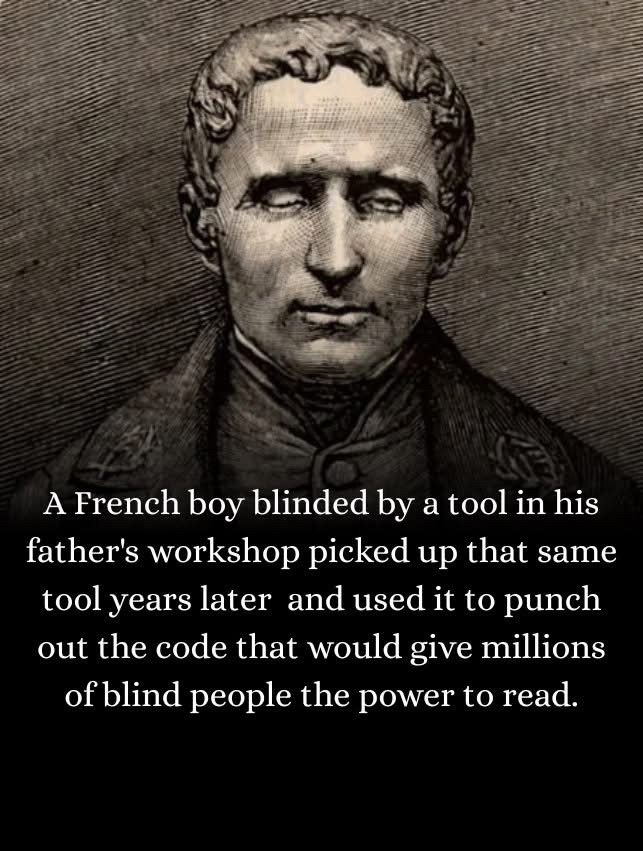
A French boy blinded by a tool in his father's workshop picked up that same tool years later — and used it to punch out the code that would give millions of blind people the power to read. THE ACCIDENT It was 1812. In a small village called Coupvray, about forty kilometers east of Paris, a three-year-old boy named Louis Braille was playing in his father's saddlery shop. He watched his father, Simon-René, carefully punch holes into leather using a sharp tool called an awl. Louis wanted to try. The awl slipped. It struck his left eye. The village doctors did what they could — herbal salves, bandages — but in 1812, there was nothing they could really do. The wound became infected. Then the infection crossed to the other eye. By the time Louis was five years old, he was completely and permanently blind. THE FAMILY THAT REFUSED TO GIVE UP In early 19th-century France, blindness was a sentence. Disabled children were routinely hidden away, used as street entertainment, or left to beg. Louis's family refused all of it. His father made him a wooden board studded with round-headed nails, arranged in the shapes of letters, so Louis could learn the alphabet by touch. His mother insisted he continue his chores. The village priest tutored him privately. The village schoolmaster let him sit in on classes — where he out-performed every sighted student in the room. By the time Louis was ten, they had won him a scholarship to one of the most extraordinary schools on earth: the Royal Institute for Blind Youth in Paris, the very first school for the blind ever founded. THE LIBRARY OF THREE BOOKS When Louis arrived in Paris in 1819, he made a devastating discovery. The school library contained just three books. Only three. Books for the blind existed, but they were printed with enormous embossed letters pressed into thick wax paper. Each book took months to produce, cost a fortune, and required readers to trace slow, clumsy shapes with their fingertips. Most blind students never became
2 days ago

The Adams
Thanks for Louis story. I always wanted to know the story, but kept forgetting to look it up. This is very Interesting..
2d
Jacksonville, FL
Reply(1)
1

Shawn
It was an Awl(Very tough ice pick), I worked for and with the blind for last 15 years.
1d
Steelton, PA
Reply
More comments ...
write a comment...