1/1

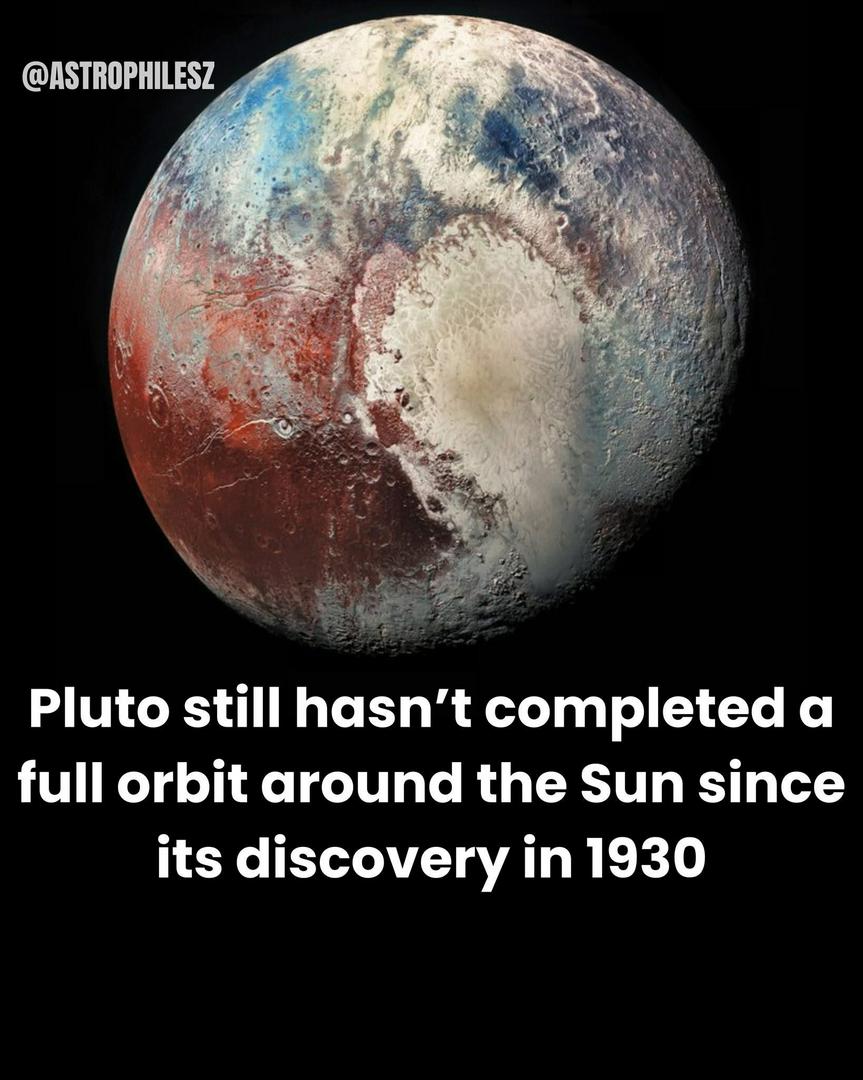
Pluto still has not completed a single full orbit around the Sun since the day humans discovered it in 1930. Let that land for a second. We found Pluto, argued about whether it was a planet, stripped it of its planetary status, sent a spacecraft all the way out there to photograph it, and named features on its surface. And in all that time, in nearly a hundred years of human history, Pluto has not even made it once around the Sun. That is because a single Pluto year lasts 248 Earth years. It will not complete the orbit it was on when Clyde Tombaugh first spotted it in February 1930 until the year 2178. Nobody alive today will be here to see it finish. To put that timeline in perspective, when Pluto was discovered, commercial air travel did not exist yet. Television had not been invented. World War Two had not happened. The entire modern world as we know it, the internet, space travel, smartphones, the mapping of the human genome, all of it unfolded in less than half of one Pluto year. And Pluto just kept moving at its own quiet pace, completely indifferent to everything happening on this tiny warm planet it has never orbited close to. This is what the outer solar system does to your sense of time. Out there, everything operates on scales that make human history look like a footnote. Neptune takes 165 years to orbit the Sun. Sedna, a distant dwarf planet in the far reaches of the solar system, takes approximately 11,400 years. There are objects out in the Oort Cloud with orbital periods measured in millions of years. Rocks that began their journey around the Sun before modern humans existed and will not finish it until long after we are gone. We talk about space in terms of distance. How far away things are. How long light takes to reach them. But the timescales of orbital mechanics are just as staggering. Just as humbling. Pluto is out there right now, continuing the same slow arc it has been tracing since long before we had any idea it existed. Patient in a
2 hours ago

shewhorunfromcold
👍🏼
1h
Greer, SC
Reply
More comments ...
write a comment...