1/1

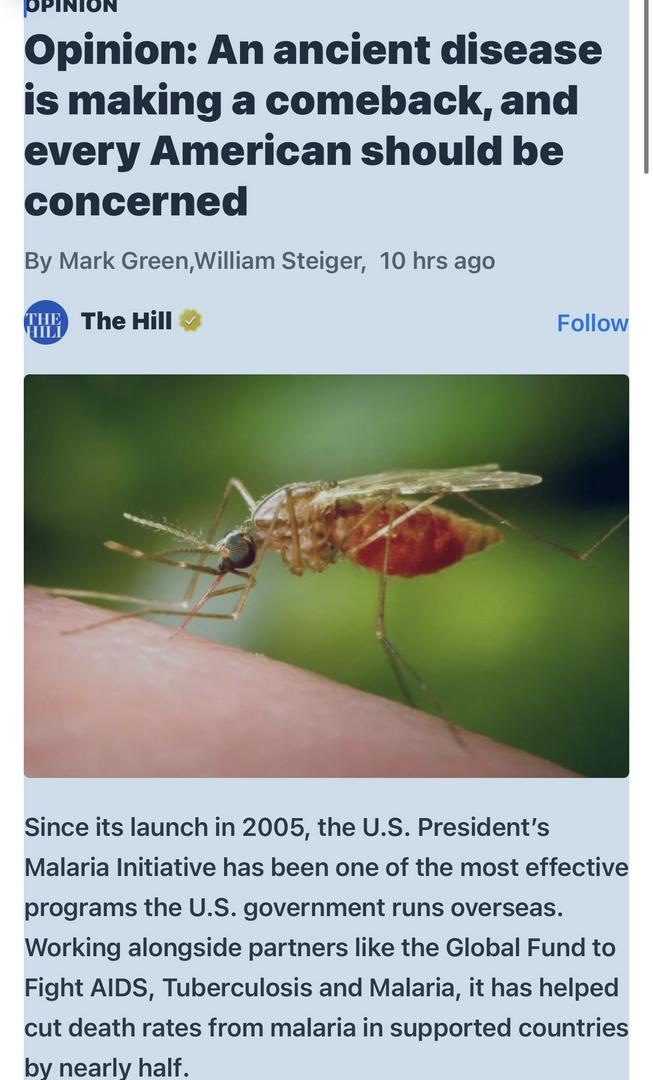
OPINION Opinion: An ancient disease is making a comeback, By Mark Green,William Steiger, Since its launch in 2005, the U.S. President’s Malaria Initiative has been one of the most effective programs the U.S. government runs overseas. Working alongside partners like the Global Fund to Fight AIDS, Tuberculosis and Malaria, it has helped cut death rates from malaria in supported countries by nearly half. These efforts have prevented more than 2 billion cases of malaria and saved 14 million lives — most of them children. In doing so, it stands as a clear demonstration of American leadership and reinforces the United States’ reputation as a reliable partner committed to saving lives and strengthening global health security. But data shows progress is slowing in some parts of the world because the disease itself is evolving. Mosquitoes are adapting to the tools we have used for decades, and the drugs and insecticides that once worked are losing their edge. Malaria is now the leading killer of children in many African countries. A renewed emphasis on fighting malaria should be central to the Trump administration’s America First Global Health Strategy. When infectious diseases come roaring back, they don’t just stay “over there.” They threaten our economic and national security here in the U.S. The president’s strategy promises a disciplined approach to global health aid, rightly prioritizing areas where the U.S. holds a distinct advantage — particularly through American innovation — rather than attempting to do everything everywhere. Malaria is well-suited to this vision. Breakthrough technologies developed and manufactured in the U.S. have the potential to reduce the transmission of malaria sharply if deployed at scale. New spatial repellents from SC Johnson, for example, can protect families without requiring constant compliance.
1 days ago

Brandon Lopez
y7e d
12h
Lancaster, PA
Reply
More comments ...
write a comment...