1/1

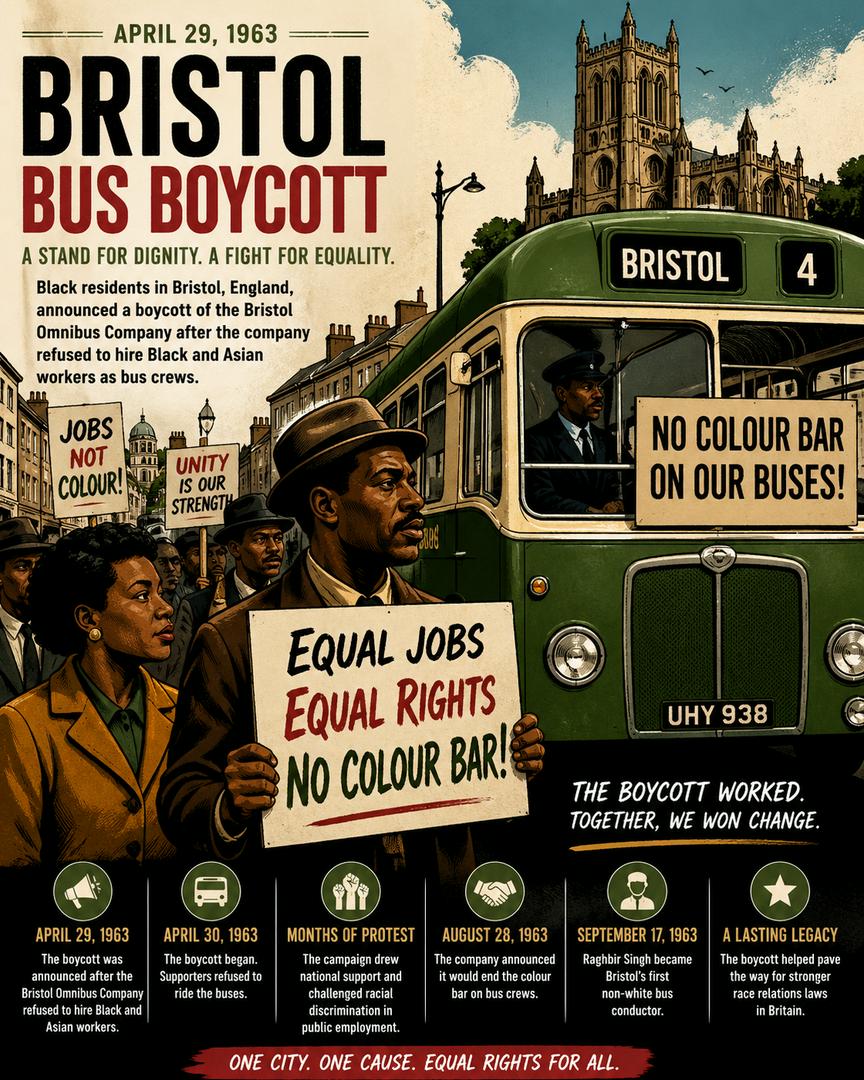
On April 29, 1963, civil rights organizers in Bristol, England announced a boycott of the Bristol Omnibus Company after the company refused to hire Black and Asian workers as bus crews. At the center of the campaign were members of the West Indian Development Council, including Roy Hackett, Owen Henry, Audley Evans, and Prince Brown. Paul Stephenson, a youth worker and activist, became one of the public voices of the protest. The issue came into sharper focus after Guy Bailey, a young West Indian man, was denied an interview for a bus crew job once the company learned he was Black. The rejection exposed what many in the community already knew: Bristol’s bus company and union had allowed a “colour bar” that kept non-white workers from becoming drivers or conductors. The boycott officially began on April 30, 1963. Supporters refused to ride the buses, and the campaign gained attention across Britain. It was not only about one job or one company. It was about whether Black and Asian residents could be blocked from public employment while still being expected to live, work, pay fares, and contribute to the city. The protest lasted for several months. On August 28, 1963, the same day Dr. Martin Luther King Jr. delivered his “I Have a Dream” speech in Washington, D.C., the Bristol Omnibus Company announced that racial discrimination in hiring bus crews would end. On September 17, 1963, Raghbir Singh became Bristol’s first non-white bus conductor. Other workers followed. The Bristol Bus Boycott became a landmark moment in Black British history. It showed how organized community pressure could challenge discrimination directly. The campaign is also remembered as one of the events that helped push Britain toward stronger race relations laws in the 1960s. What happened in Bristol was not just a local transportation dispute. It was a public stand against exclusion, and it helped change the direction of civil rights history in Britain. #BlackHistory #BristolBusBoycott
2026-04-29

Pierce Hawke
I thought Jim Crow in the UK wasn't a thing since several bar owners put the USA based segregation rules for our Armed Forces during WW II to the test. 🤔
04-30
Bullhead City, AZ
Reply
1

BV B
Thank you, I never knew that
04-29
Annapolis, MD
Reply
2

Achan
nice post
04-30
Norfolk, VA
Reply(1)
2

Guest
we should be boycotting this racist regime of the moment in our lives
30d
Santa Fe, NM
Reply
More comments ...
write a comment...