1/1

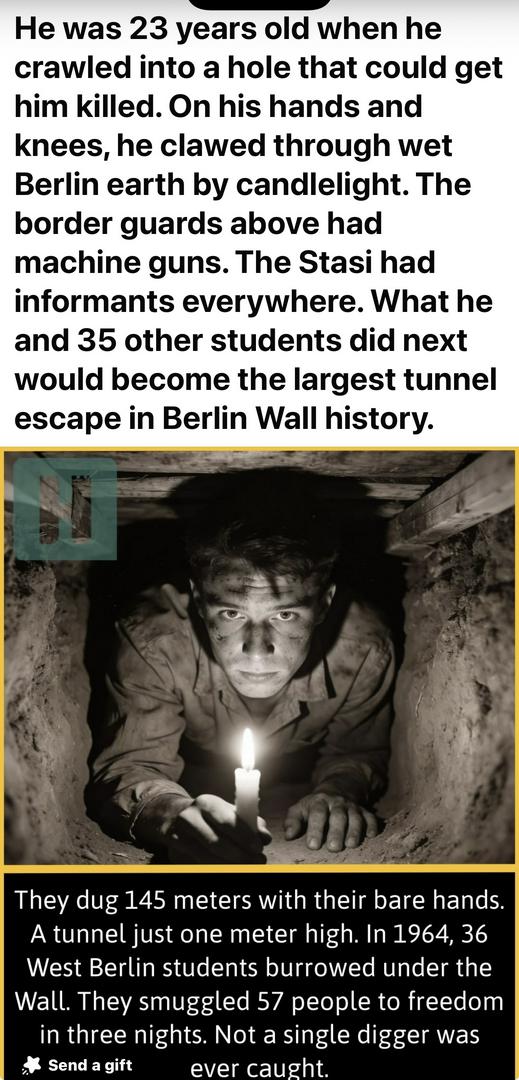
The tunnel began in the back room of a bakery at 97 Bernauer Strasse in West Berlin. From there, a group of students from the Technical University of Berlin dug a narrow passage 145 meters eastward, staying just below the death strip. They worked in rotating shifts of three men. One dug, one hauled dirt in a wooden cart, and one stood watch. The tunnel was barely one meter high and 60 centimeters wide. Too small to stand. Too narrow to turn around. The diggers used teaspoons, trowels, and their own hands to remove over 100 tons of earth. They spread the dirt across multiple construction sites to avoid detection. They installed electric lighting stolen from university labs. They built a rail system using a children's wagon to move the dirt faster. The operation took nearly six months of nightly work, always in silence, always in fear of collapse. On the night of October 3, 1964, the tunnel breached the surface inside a public toilet on the East Berlin side. Over the next three nights, 57 East Germans crawled through the darkness to freedom. Among them were entire families. Grandparents. Children as young as three years old. They arrived in the West covered in dirt, shaking, but free. Not one was caught. The tunnel was discovered by East German authorities on October 7. They sealed it with concrete. But the diggers had already vanished back into their student lives. Some went on to become engineers, professors, and architects. None were ever prosecuted. The tunnel had cost 10,000 West German marks to build. It was funded by donations and a West German television network in exchange for exclusive filming rights. The footage of those 57 people emerging from the earth became one of the defining images of Cold War Berlin.
2026-04-30

chicken-farmer
Interesting article 👍 ,thank you" , for posting..
30d
Crystal River, FL
Reply

Tedda Wibberley
thank you.
28d
Rochester, NY
Reply
More comments ...
write a comment...