1/1

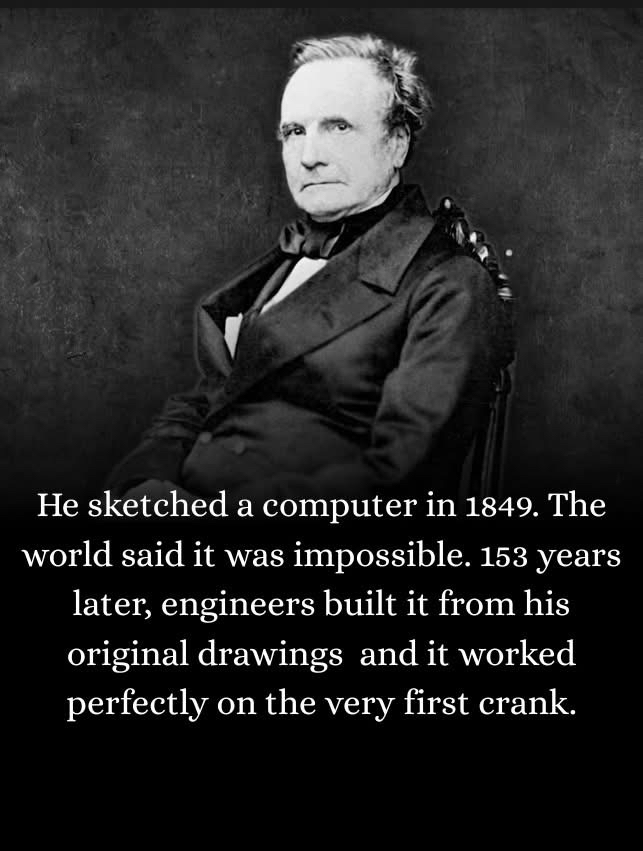
In the summer of 1821, a frustrated mathematician named Charles Babbage sat in a London study, surrounded by stacks of astronomical tables. Page after page, he found mistakes — small numerical errors that ships' captains relied on to navigate the world's oceans. A single wrong digit could send a vessel onto rocks. Lives depended on numbers calculated by tired humans, copied by hand, set by typesetters, and printed under candlelight. Exhausted, Babbage slammed the book shut His friend John Herschel looked up and said quietly: "It is quite possible." That single moment lit a fire that would burn for the rest of Babbage's life. He went home and began designing something the world had never seen — a colossal mechanical brain. A machine made entirely of brass, bronze, and cast iron, with thousands of interlocking gears, wheels, and levers, that could calculate complex mathematical tables without a single error. He called it the Difference Engine. The British government was intrigued. They gave him funding. The world watched. But Babbage was a man cursed with a vision too far ahead of the tools available to build it. The metalwork required precision that 19th-century factories could barely achieve. Costs spiraled. Deadlines slipped. He quarrelled with his master engineer. By 1842, after spending over £17,000 of public money — equivalent to the cost of 22 steam locomotives — the government walked away. Babbage was devastated. But he didn't stop. In private, he kept designing. Between 1847 and 1849, he drafted an even more elegant version: Difference Engine No. 2. Eleven feet long. Seven feet tall. Five tons of metal. Eight thousand precision parts. It could calculate up to 31-digit numbers and print the results directly onto stereotype plates He never built it. He died in 1871, his greatest invention still locked in ink on paper. The world moved on.
22 days ago

chicken-farmer
🤔 Very interesting article 👍 , thank you for posting...
19d
Crystal River, FL
Reply
More comments ...
write a comment...