1/1
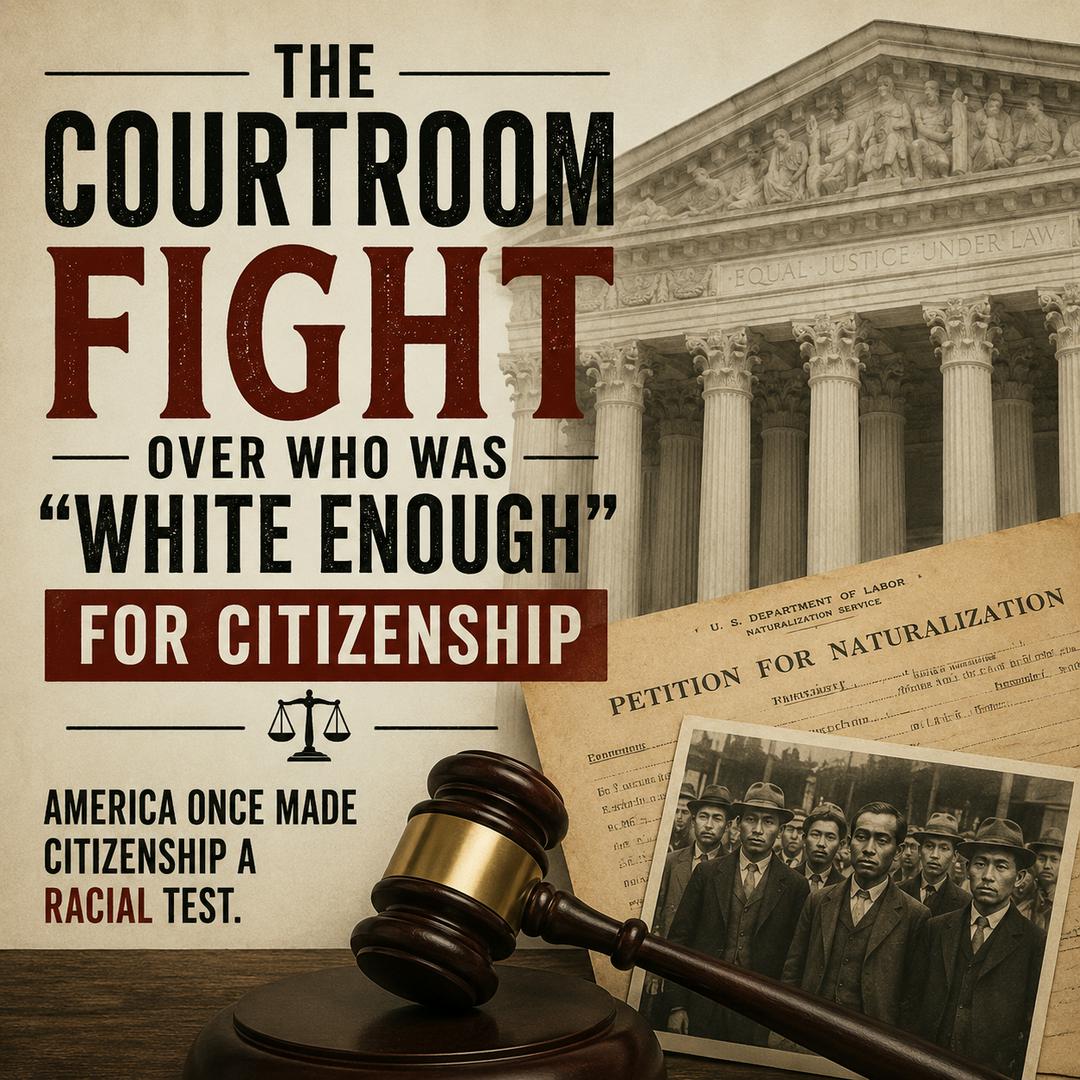
There was a time in American history when becoming a citizen was not only about paperwork, residency, or loyalty. For many immigrants, it also came down to whether a court considered them “white enough.” Early U.S. naturalization law limited citizenship to “free white persons.” In 1870, eligibility was extended to people of African nativity and African descent, but many other nonwhite immigrants were still shut out. That legal line created a disturbing question: who counted as white? In 1922, Takao Ozawa, a Japanese immigrant who had lived in the United States for years, asked the Supreme Court to recognize him as eligible for citizenship. He argued that he had embraced American life and that his skin was light enough to qualify under the law. The Court rejected him, saying “white person” meant someone of the Caucasian race. Then in 1923, Bhagat Singh Thind, an Indian immigrant and World War I veteran, made a different argument. Since some racial theories of the time classified Indians as Caucasian, he argued that he should qualify. The Court rejected him too. That is where the contradiction became impossible to ignore. When Ozawa argued based on appearance and assimilation, the Court leaned on racial science. When Thind argued based on racial science, the Court leaned on what it called common understanding. In plain language, the rules changed depending on who was standing at the door. These cases show how citizenship was shaped by racial boundaries that could move whenever power wanted them to move. It was not about fairness. It was not about loyalty. It was about protecting a legal idea of America that decided some people belonged and others did not. The phrase “white enough” sounds absurd now, but for many people, it was once a serious legal question. The answer could affect their rights, property, security, and future. History did not only happen in the streets. Sometimes, it wore a robe, sat behind a bench, and called exclusion the law. #History
23 days ago

Eagle515lake
There were also serious debates in some state legislatures as to whether Italian immigrants were “white”. Several Italian immigrants were lynched in New Orleans because they were accused of raping white women (never proved) & were considered non-white. Look it up…
22d
Sarasota, FL
Reply
2

Angela Gioe
Well, it’s an Ungodly Fight and Color of skin has no power, only the evil heart! One American People As We were Founded and Not What democrats as usual since they’ve been around have always tried doing and that is dividing our nation! God Made One Race and that’s the Human Race. Anything that breaks that up into evil deeds as democrats do, For Example, Jim Crow, , KKK, Abortion Advocating & Celebrating Romans 1:18-32 , and Castrating little boys Are in Spiritual darkness. Before the 60’s downfall of our nation all this new nonsense and evil has never been thought To Be, Cause Most if not all had a more Christian/ Jewdao perspective in Society and even pagans or unbelievers had better kindness in actions and words as Christians. The evil has permeated into every nook and cranny of every department in our nation. Keep praying cause The Lord Hears and Works Out Everything Good To Those Who Love Him. 🙏🏻🇺🇸❤️👆🙌
23d
Reply
1

Princess
the root cause of dividing this nation, all along has been, the kingdom of darkness-satan himself through the will of wicked people . Evil, against the will of God, for all of humanity. the color of your skin will not save those involved in them acts of discrimination and sin . all of wickedness will , and are facing the wrath of God that does not discriminate😲😲wake up people! REPENT! We all reap what we sow. nobody is exempt!
22d
Santa Barbara, CA
Reply

Pierce Hawke
Yet Chang and Eng Bunker; despite being from Thailand, didn't have trouble integrating into the pre Civil War South and their mixed Eurasian kids were listed as 'White'. 🤔
21d
Bullhead City, AZ
Reply

Whoratio
We used to be a proper country
23d
Littleton, CO
Reply
2

THETRUTH
white enough. yet the average hickkk cant stand to hear someone use the term racism or racist. plus im white.
20d
Greencastle, PA
Reply

frank todd
Disgusting all around
23d
Bear Creek, NC
Reply

Janice Michael
Scary!
22d
Gas City, IN
Reply
More comments ...
write a comment...