1/1

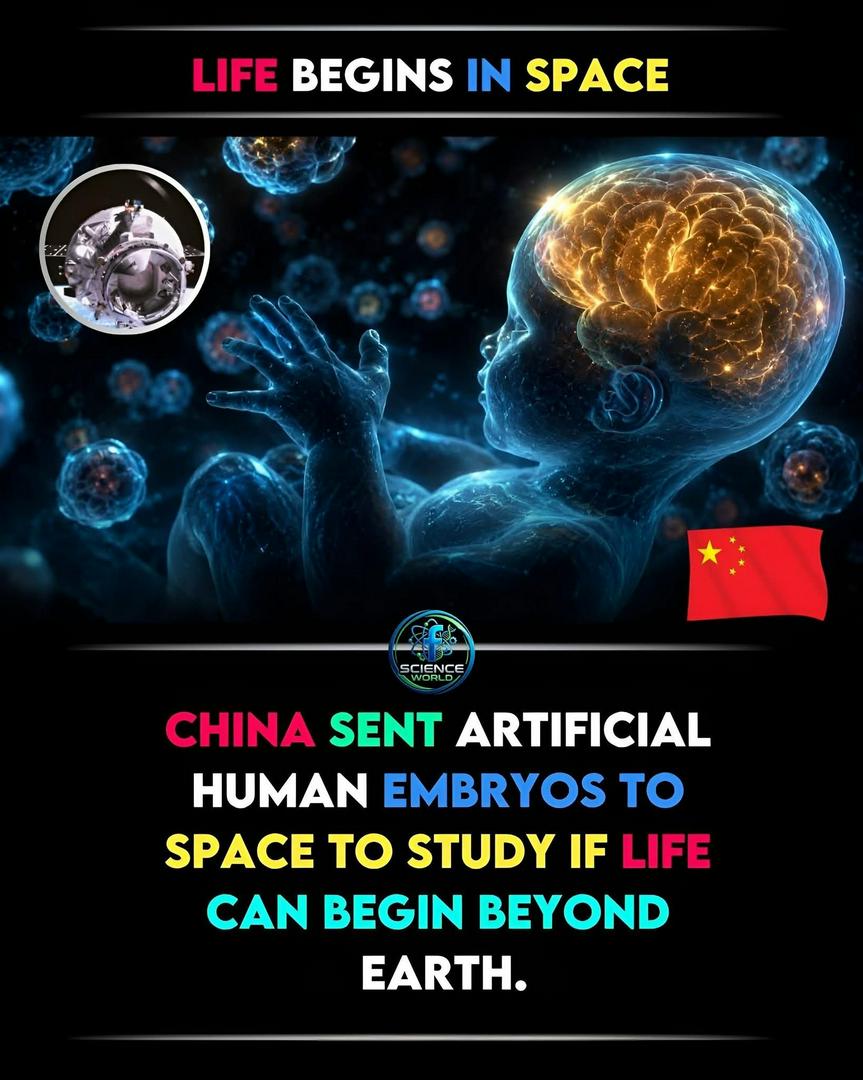
For the first time in history, artificial human embryos are being studied in outer space. 🚀 China launched the Tianzhou-10 cargo spacecraft on May 11, 2026, carrying stem cell-derived artificial human embryos to its Tiangong space station. These are not real human lives. They are lab-grown structures that resemble early-stage embryos but cannot develop into babies. Scientists are studying a critical window equivalent to 14 to 21 days after fertilization, when the foundations of major organs begin to form. The experiment will run for five days aboard the station under real microgravity and cosmic radiation conditions that Earth simply cannot replicate. The Technology and Engineering Center for Space Utilization under the Chinese Academy of Sciences is leading this mission alongside 40 other experiments. 🧬 Automated systems will replace nutrient solutions daily to keep the embryos stable, and samples will be frozen in orbit before returning to Earth for analysis. If humanity ever hopes to live and reproduce beyond our planet on the Moon or Mars, we must first understand whether life can even begin in space. ✨ This experiment may hold that answer. 📚 Source: Yu Leqian et al., Chinese Academy of Sciences Technology and Engineering Center for Space Utilization, 2026. China Manned Space Agency. #spacescience #China #tianzhou10
28 days ago

shewhorunfromcold
Circulatory system in humans use gravity, why the venous system has valves.
28d
Plainfield, IN
Reply

Angi K Mitchell-Davison
This is ridiculous
27d
Eugene, OR
Reply
More comments ...
write a comment...