1/1

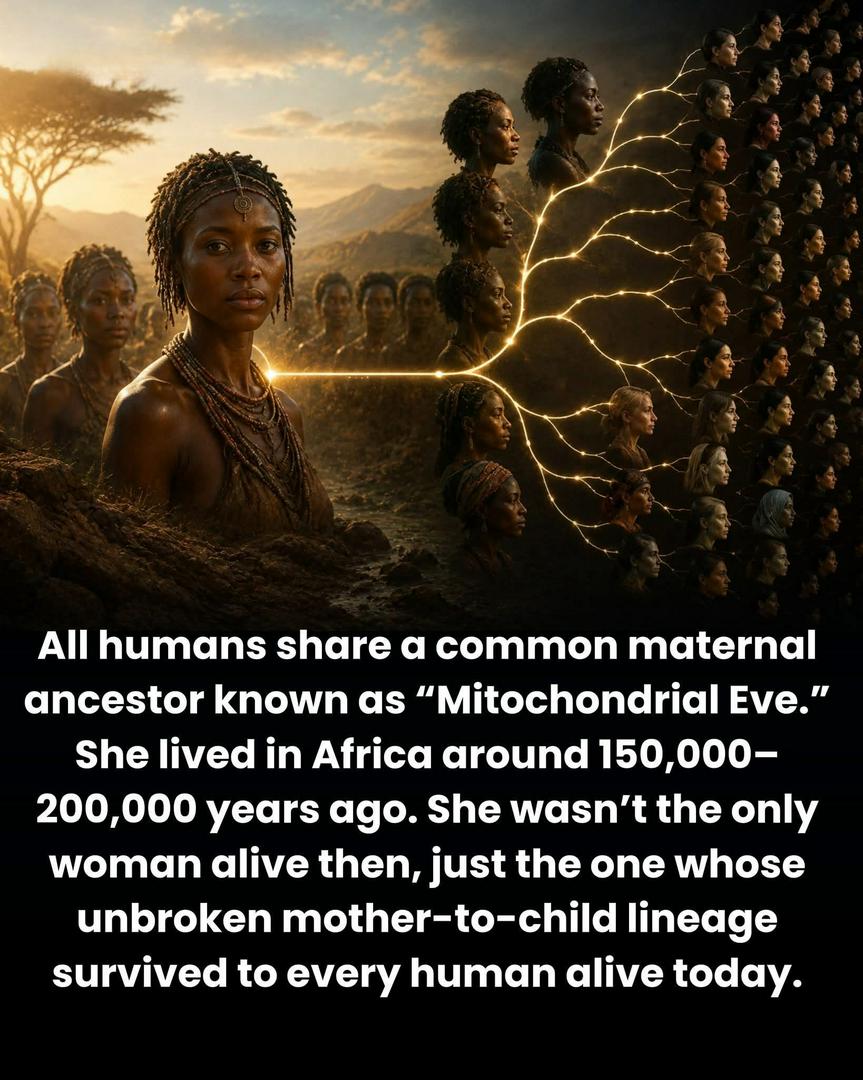
Every human being alive on Earth today, all eight billion of us, traces an unbroken line of mothers back to a single woman who lived in Africa somewhere between 150,000 and 200,000 years ago. She was not the first human. She was not the only woman alive in her time. She almost certainly never met more than a few hundred people in her entire life and had no way of knowing that the particular chain of daughters she started would outlast every other maternal line on the planet. She was simply the woman whose lineage never broke. Every other line, at some point across those thousands of generations, ended with someone who had no daughters, or whose daughters had no daughters Scientists call her Mitochondrial Eve, and the reason we can identify her at all comes down to a peculiarity of biology. Mitochondria, the energy-producing structures inside every human cell, carry their own separate DNA. Unlike the DNA in your chromosomes, which is reshuffled with every generation, mitochondrial DNA is passed almost unchanged from mother to child. It mutates slowly and predictably, which means geneticists can read it like a molecular clock, tracing mutations backward through generations to calculate when all living human lineages converge at a single point. What this reveals is not that humanity descended from one woman, but that the human family tree is not a tree at all. It is a constantly narrowing funnel of surviving lineages. At any given moment in history, countless bloodlines are quietly ending while others persist. The ones that survive long enough accumulate into something we can eventually trace backward. She had a male equivalent. Researchers call him Y-chromosomal Adam, the most recent common patrilineal ancestor of all living men, traced through the Y chromosome the same way. Intriguingly, the two did not live at the same time.
2026-05-18

rachel
lies
05-19
Harrison, AR
Reply(1)
1

Angela Gioe
The Whole World Of humans Trace Back To Adam & Eve, And Our Only Hope Is In A Holy, Righteous Savior Who Came Down To Save All People Who Believe The Gospel Alone In Christ Alone. It’s Written, If Anybody Adds or Takes Away From Gods Written Word. They’re Already Condemned. 🙏🏻❤️
05-19
Reply(13)
12

Halee Thornton
y'all not from the caucus mountains. you guys showed up and Scandinavia around 7,000 years ago we're millions of years old. chat GPT will tell you how old we are verification is there
05-19
Toledo, OH
Reply(28)
10

David Peterson
Every human on earth today can trace their lineage back to Adam and Eve through Noah. 🙏
05-19
Bradenton, FL
Reply(4)
6

Thomas Sasser
There’s not 8 billion as far as I can tell after I go through all the data and balances out to, but maybe less than 5 billion and probably even less than that. Sorry.
05-19
Juneau, AK
Reply(1)
2

lost
I read an article that says all blue eyed people come from a one time mutation and can be traced to one person we all share the DNA of 🤔.
05-19
Manteo, NC
Reply
2

Timothy
not according to the word of God that I've read

05-19
Houston, TX
Reply(11)
11

Jennifer T
I've read these comments and lost all hope in American education. 🤦♀️🙄
05-19
Reply(4)
6

CHINAownsTHISapp
there is zero proof that she was black just because it was in Africa doesn't mean Africa is where Africa is today Africa could have been up in the Caucasian mountains
05-19
Whitelaw, WI
Reply(4)
1
More comments ...
write a comment...