1/1

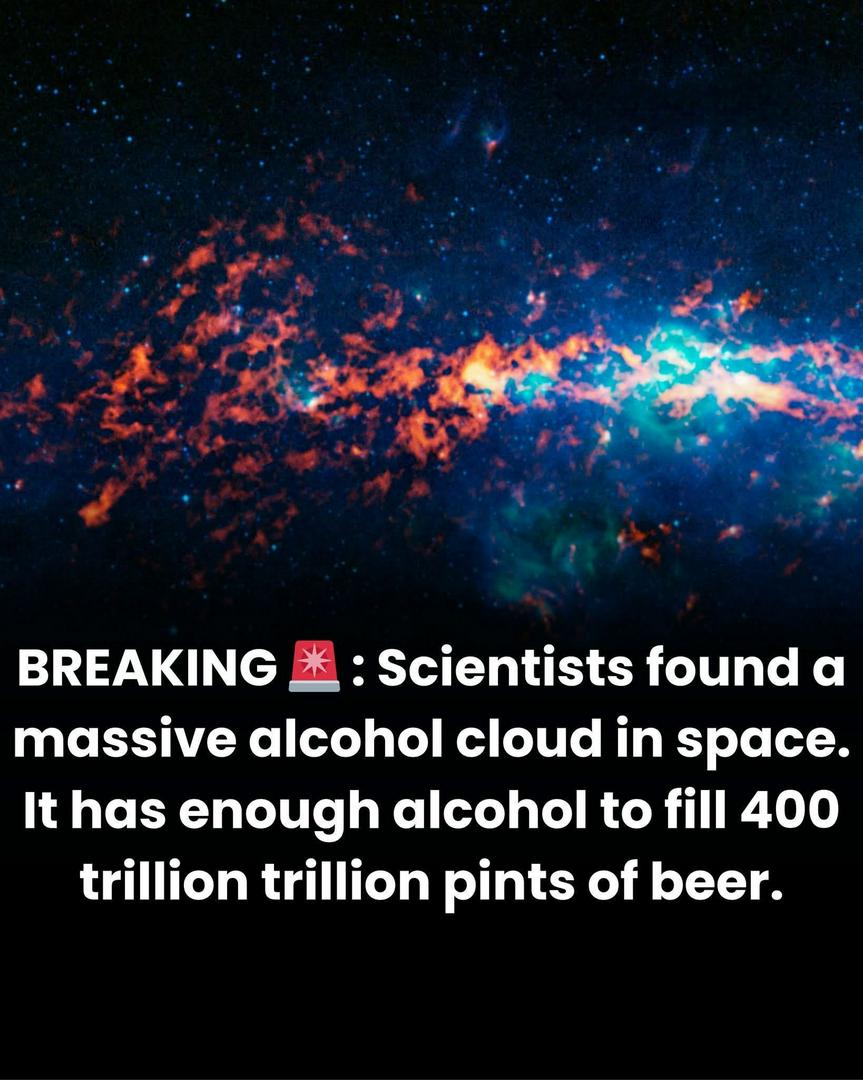
Somewhere near the centre of our galaxy, approximately 26,000 light years from Earth, there is a cloud of alcohol floating in space. Not a small one. A cloud containing enough ethanol to fill 400 trillion trillion pints of beer. The number is so large it has stopped being a number and become more of a philosophical statement about the size of the universe. The cloud is called Sagittarius B2, a massive molecular cloud sitting near the galactic centre that has been studied by radio astronomers since the 1970s. It spans roughly 150 light years across and contains a staggering variety of organic molecules, including ethanol, which is the same alcohol found in every drink ever fermented on Earth, along with vinyl alcohol, ethylene glycol, glycolaldehyde, and dozens of other carbon-based compounds. Before anyone books a flight: the alcohol exists as a diffuse gas at concentrations so thin that a human walking through it would not be able to smell it, let alone drink it. It is spread across an incomprehensible volume of space at densities far below what any laboratory on Earth would classify as measurable. The cloud is also saturated with other, far less pleasant molecules, including hydrogen cyanide and carbon monoxide. What makes Sagittarius B2 genuinely significant is not the beer equivalent. It is what the presence of complex organic molecules in interstellar space tells us about chemistry. These compounds do not require planets or oceans or biology to form. They assemble spontaneously in the cold, radiation-bathed environment of space, driven by chemistry acting on simple elements over vast timescales. The same building blocks of life, amino acid precursors, simple sugars, alcohols, are found throughout the galaxy in clouds just like this one. When a solar system forms from a collapsing molecular cloud, it inherits that chemical inventory.
2026-05-24

fish
Nah it’s simply Whiskey Pete’s Space Force Headquarters
05-24
El Centro, CA
Reply
1

Wes Graff
why do i suddenly want to be an astronaut? take me to the boozeiverse.
05-26
Quincy, IL
Reply

Megan Kramer
We just have to find the pizza. Beer with pizza, nothing better!
05-26
Cedar Crest, NM
Reply

Early Hippie
enough to turn a battleship around 👍
05-24
Reply

Janice Michael
Weird! But interesting!
05-25
Gas City, IN
Reply

Kenneth Tsyitee
😲
05-25
Albuquerque, NM
Reply
More comments ...
write a comment...