1/1

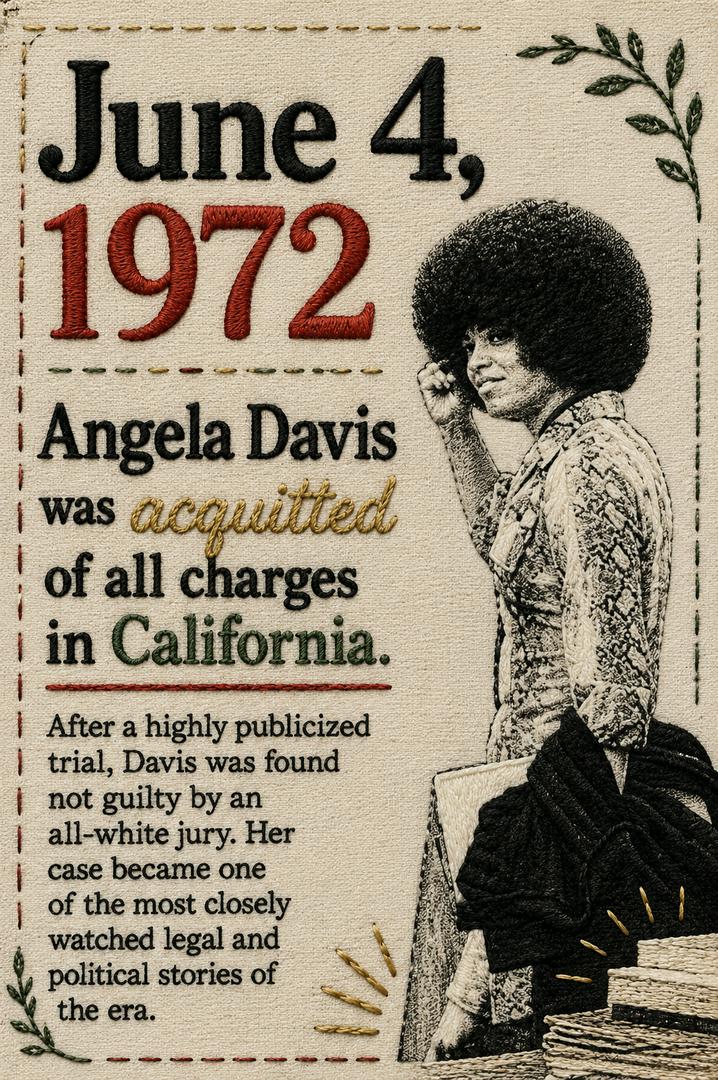
On June 4, 1972, Angela Davis was acquitted of all charges in California, ending one of the most closely watched legal and political trials of the era. Davis, a scholar, activist, and former professor, had been charged in connection with a 1970 courthouse incident in Marin County, California, where firearms registered in her name were used during an attempted courtroom takeover that left four people dead. Prosecutors argued that her connection to the weapons tied her to the crime. Davis maintained that she had no role in planning, directing, or carrying out the events. Her arrest drew worldwide attention. Supporters launched an international campaign calling for her release, while opponents viewed the case as a test of how far political activism could go during a period marked by civil rights struggles, antiwar protests, and growing social unrest. After months of testimony and deliberation, the jury found Davis not guilty on all charges. Jurors concluded that prosecutors had failed to prove she had participated in or conspired in the incident. The verdict became a landmark moment in American legal history. To many, it reinforced the principle that criminal responsibility must be proven beyond a reasonable doubt, regardless of a defendant’s political beliefs or public profile. More than 50 years later, the Angela Davis trial remains one of the most significant courtroom cases of the twentieth century and continues to shape conversations about race, activism, political dissent, and the justice system. #OnThisDay #BlackHistory #AngelaDavis
Marin County, California • 22 days ago

Kathy Stokes
She was a remarkable activist and very smart 👏🏽🙏🏽🕊️
16d
Chicago, IL
Reply
More comments ...
write a comment...