1/1

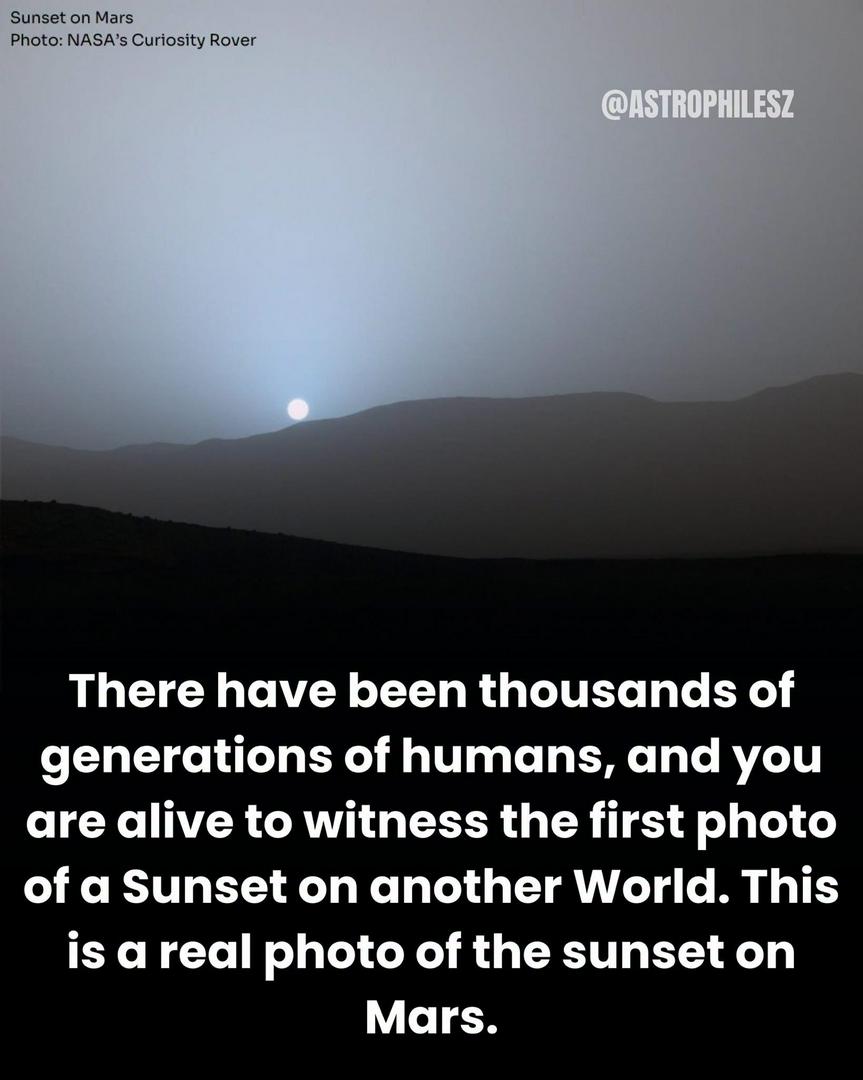
Every human who ever lived watched the sun go down on Earth. You are among the first to see it go down somewhere else. This photograph was taken by NASA's Curiosity Rover on Mars. The Sun is smaller here than it appears from Earth, because Mars sits about 50 percent further from it. And the colors are inverted from what you would expect. On Earth, sunsets are red and orange because dust scatters blue light away. On Mars, fine iron oxide particles in the atmosphere do the opposite, scattering red light and allowing blue to pass through. The horizon glows blue while the rest of the sky runs a dusty pink. The Martian day is 24 hours and 37 minutes long, just slightly longer than ours. Gravity on the surface is about 38 percent of Earth's. The temperature at sunset can drop to minus 60 degrees Celsius within minutes. Nobody was standing there to feel it. A rover the size of a car, built by humans on a different planet, pointed its camera at the horizon and sent the image home across 225 million kilometres of empty space. What makes this image genuinely strange to sit with is the timescale it spans. Modern humans have existed for roughly 300,000 years. For all of that time, every sunset any human ever experienced happened on one world. The first Mars sunset photograph was taken in 2015. That gap, from the first humans watching a sun drop behind a horizon to the moment we captured it happening on another planet, is the distance between everything our species was and whatever it is becoming. The Sun in this image is the same star your ancestors watched set for a hundred thousand generations. It just looks different from here.
12 hours ago
write a comment...