1/1

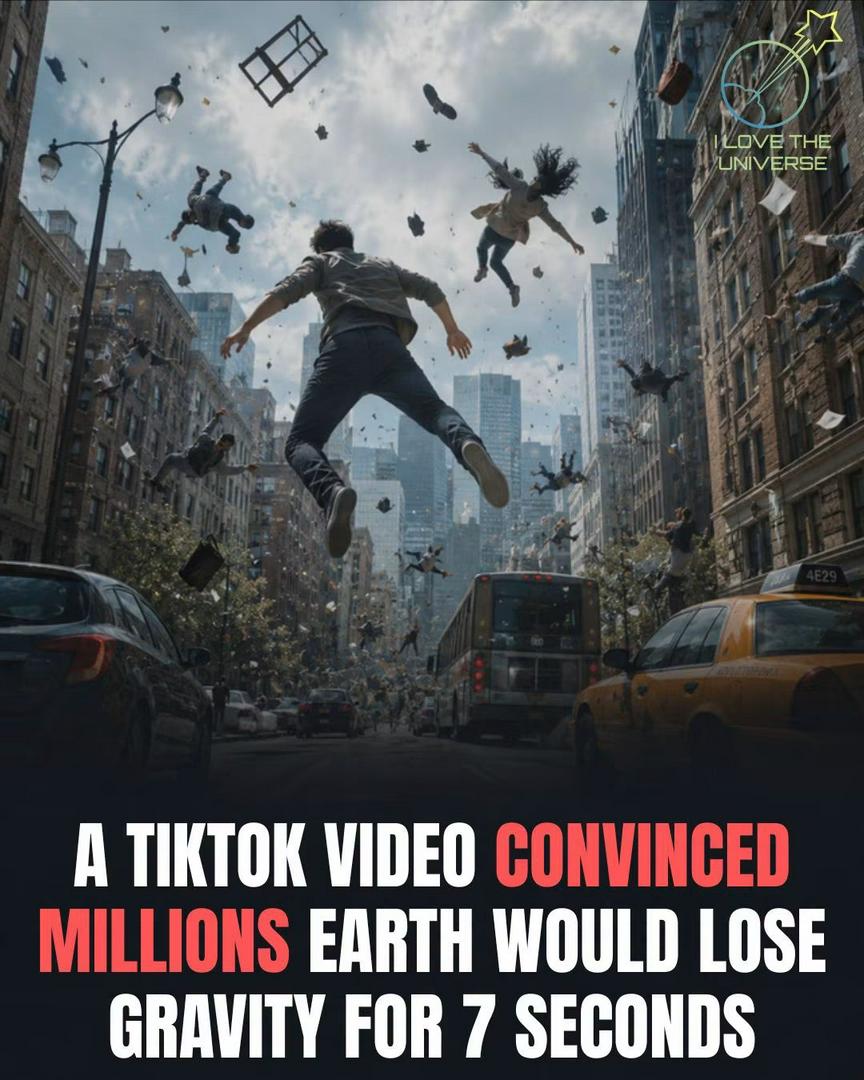
Yesterday, the internet said gravity would switch off for 7 seconds. Spoiler: it didn't. If you saw a video claiming Earth would lose gravity on August 12, 2026 — sending 40-60 million people floating to their deaths — you weren't alone. The claim, built around a supposedly leaked NASA document and a made-up "94.7% probability" collision of gravitational waves, racked up tens of thousands of likes and hundreds of thousands of shares before it was debunked. Here's why it was always nonsense: 🌍 Gravity isn't a switch. It's a direct consequence of mass. Any object with mass bends spacetime around it and produces a gravitational field — full stop. The only way to "turn off" Earth's gravity would be to get rid of the planet's core, mantle, and crust entirely. At that point, you no longer have a planet to worry about falling off of. 🌊 Gravitational waves don't work that way either. They're so faint that detecting them required building some of the most sensitive instruments ever made. They also only carry information about the final moments of a cosmic collision — they can't be "predicted" years in advance the way the rumor claimed. And it isn't even NASA that studies them — that's the job of the LIGO-Virgo-KAGRA collaboration. ☀️ The timing wasn't random. August 12 was picked because it's the date of 2026's total solar eclipse, visible from the Arctic to Spain. Linking eclipses to disaster is one of humanity's oldest habits, even though we've been able to predict them mathematically for thousands of years. So why did millions believe it? Because fear spreads faster than fact-checking. A confident tone, a fake "leaked document," and a specific number of seconds and casualties make a claim feel scientific, even when it violates basic physics that most of us learned in school (Newton's first law alone rules out anyone floating 20 meters into the air).
2 hours ago
write a comment...