1/1

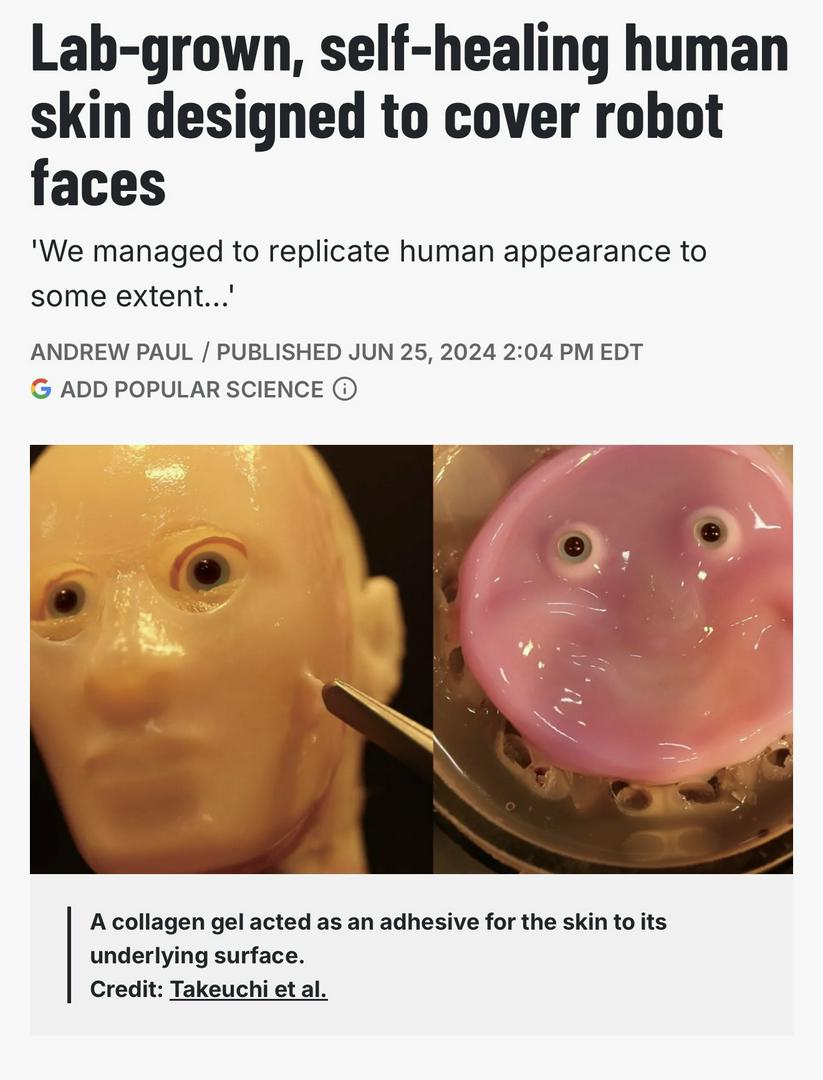
Lab-grown, self-healing human skin designed to cover robot faces 'We managed to replicate human appearance to some extent...' ANDREW PAUL PUBLISHED JUN 25, 2024 2:04 PM EDT ADD POPULAR SCIENCE (OPENS IN A NEW TAB) More information Side by side of lab grown skin on 3D and 2D human face models A collagen gel acted as an adhesive for the skin to its underlying surface. Credit: Takeuchi et al. Even after sizable industry advances, humanoid robots remain firmly within the uncanny valley. And although a Japanese team’s new lab-engineered skin may not lessen a bot’s creepiness, it may one day become a helpful medical tool for cosmetic surgery and other medical procedures. As detailed in a study published on June 25 in Cell Reports Physical Science, engineers at the University of Tokyo have developed a method to adhere bioengineered skin grown from human cells onto any surface shape. Existing approaches often rely on miniature anchors and hooks to attach similar tissues to surfaces, which limit their utility and make them easily susceptible to damage during movement. In this case, however, researchers created miniature V-shaped perforations in their lab-grown skin to make it extremely flexible, then applied a collagen gel. While the gel’s viscosity normally would prevent it from seeping into the tiny incisions, the engineers used what’s known as a water-vapor-based plasma treatment that is usually employed during plastic adhesion processes. This made the skin more hydrophilic, allowing the collagen to seep into the performations and bind the skin to its underlying surface much like ligaments. By mimicking human skin-ligament structures and by using specially made V-shaped perforations in solid materials, we found a way to bind skin to complex structures,” corresponding author and mechano-informatics professor Shoji Takeuichi said in a statement.
4 hours ago
write a comment...