1/1

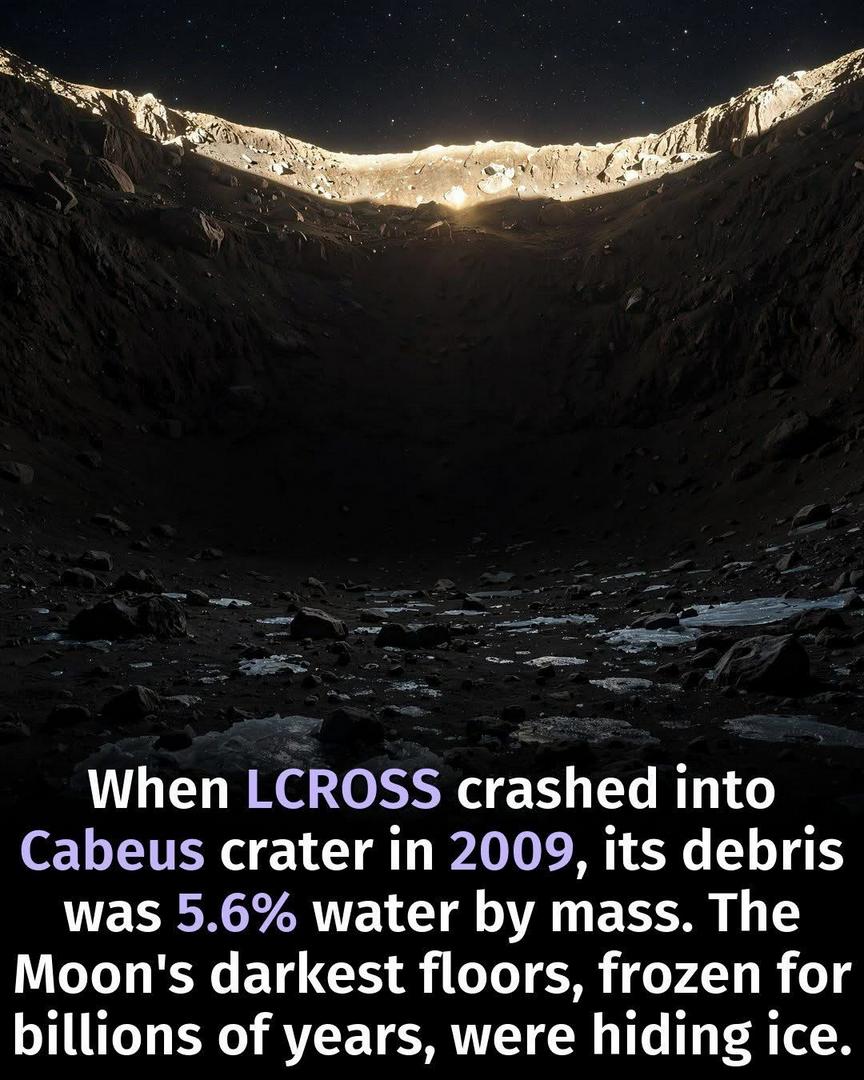
For decades the Moon's polar shadows were a perfect hiding place. At the lunar poles the Sun never rises high enough to light crater floors, so temperatures stay below -150°C for billions of years. Early hints came from Clementine in 1994, whose radar glint at the south pole might have been ice or just rough rocks, and then from Lunar Prospector, which mapped extra hydrogen at both poles from orbit. The proof required a direct hit. On October 9, 2009, NASA's LCROSS mission drove its spent Centaur stage into the permanently shadowed Cabeus crater, while a shepherding spacecraft flew through the ejecta plume. Spectrometers measured about 5.6 percent water by mass in the debris, plus other volatiles trapped in the cold. Later, NASA's Moon Mineralogy Mapper confirmed the spectral signature of water ice at the poles, and high-resolution imaging suggests parts of Shackleton crater's floor may be as much as partly ice. What looked like empty darkness is actually a deep freeze archive. #Moon #LunarScience #SpaceExploration
4 hours ago
write a comment...