Tag Page ChronicPain

#ChronicPain
The Signal Wire

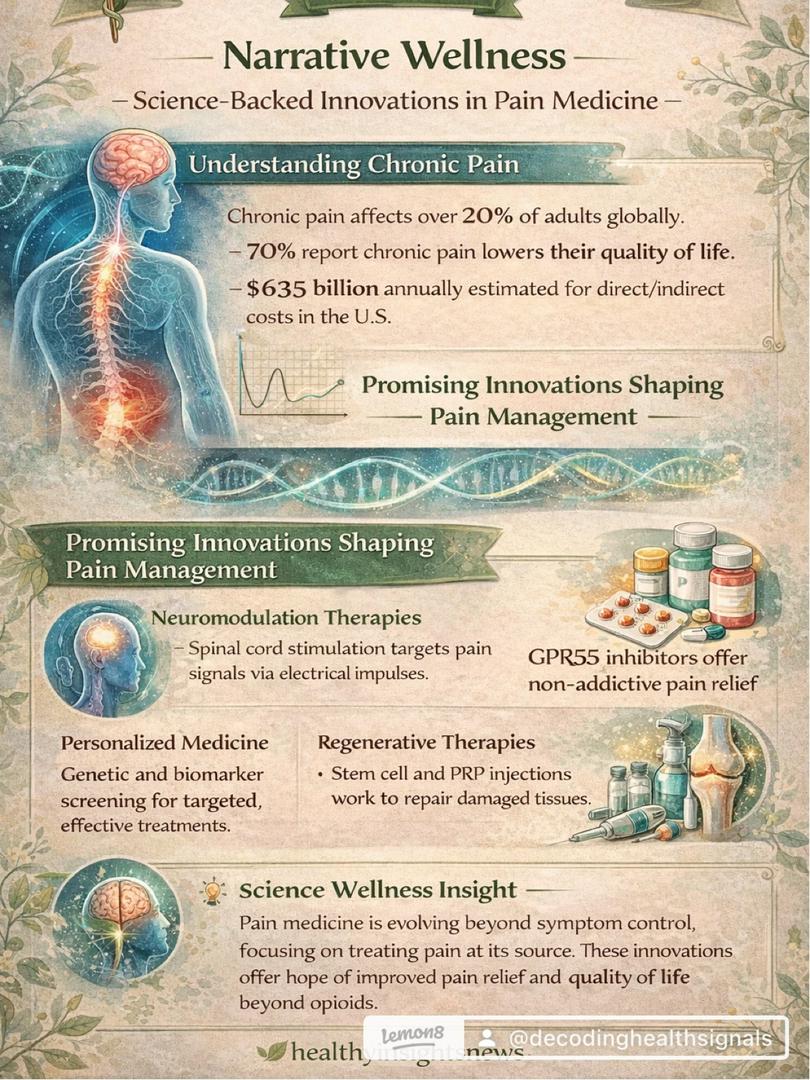
Breaking NEWS - Health Talk - The Future of Pain Medicine Pain Medicine Enters a New Era of Precision Treatment Chronic pain affects more than 20% of adults globally. • 70% report reduced quality of life • $635 billion annually in U.S. direct and indirect costs For decades, pain care centered on symptom control. Mask the signal. Suppress the inflammation. Manage the discomfort. But the signal is changing. Pain medicine is quietly transitioning from reaction to precision. Neuromodulation therapies now target pain pathways directly through electrical signaling interrupting transmission at the neural level. Genetic and biomarker screening is guiding treatment selection, reducing trial-and-error prescribing. Regenerative therapies like stem cells and PRP aim to repair tissue instead of numbing symptoms. Non-opioid molecular targets, including GPR55 pathway research, are expanding options beyond dependency risk. The industry is moving from: “Control the symptom.” to “Decode and treat the source.” This is not incremental innovation. It is structural recalibration in a post-opioid healthcare era. Pain medicine is no longer just pharmaceutical. It is neurological, regenerative, and data-driven. The question is not whether innovation is happening. The question is whether systems will adapt fast enough. Follow @thesignalwire for early detection of healthcare shifts before they scale. Is the healthcare system prepared to pivot from symptom control to signal-based, precision care? #HealthPolicy #PainInnovation #PrecisionMedicine #ChronicPain #MedicalResearch #TheSignalWire #HealthSignals #PrecisionMedicine #PainInnovation #FutureOfMedicine #HotTopic #BreakingNews #HealthNews #BiomedicalGrad #BiomedicalEngineering

Lucas Mendez

The Shoulder Pain Women Live With for Years Without a Name

Many women in their 40s and 50s develop a strange shoulder pain that limits daily life. Reaching for a bra, lifting a bag, turning in bed — everything hurts. Doctors often say it’s “just stiffness.” In reality, this is frequently frozen shoulder, a condition women develop twice as often as men, especially during perimenopause. Research shows that hormonal changes, insulin resistance, and thyroid disorders increase risk. The shoulder capsule thickens and tightens, gradually locking movement. The worst part is not the pain — it’s how long it lasts. Frozen shoulder can persist 1–3 years if untreated. Early intervention matters. Gentle physical therapy, range-of-motion exercises, managing blood sugar, and treating underlying hormonal or thyroid issues significantly shorten recovery time. Living with pain doesn’t make you strong. Getting help makes you smart. #Health #WomensHealth #ChronicPain
The Shoulder Pain Women Live With for Years Without a Name
Lucas Mendez

The Pain Women Hide Because No One Takes It Seriously

Chronic pain becomes more common after 40, yet women are far more likely to be dismissed when they seek help. A Stanford study found that women wait an average of 33% longer than men to receive pain medication in ERs. Many midlife women learn to downplay back pain, pelvic aches, or migraines because years of being told “it’s stress” or “you’re overreacting” has trained them to stay silent. But chronic pain in midlife is often rooted in hormonal shifts, reduced collagen, joint degeneration, and autoimmune activity — conditions that deserve real medical evaluation. Women aren’t “too sensitive.” Their biology is changing, and their pain pathways are different from men’s. Helpful steps: track symptoms, push for referrals, request imaging if pain persists, and find specialists experienced with midlife women. Pain is a message, not a personality flaw. #Health #WomensHealth #ChronicPain

The Pain Women Hide Because No One Takes It Seriously
You've reached the end!