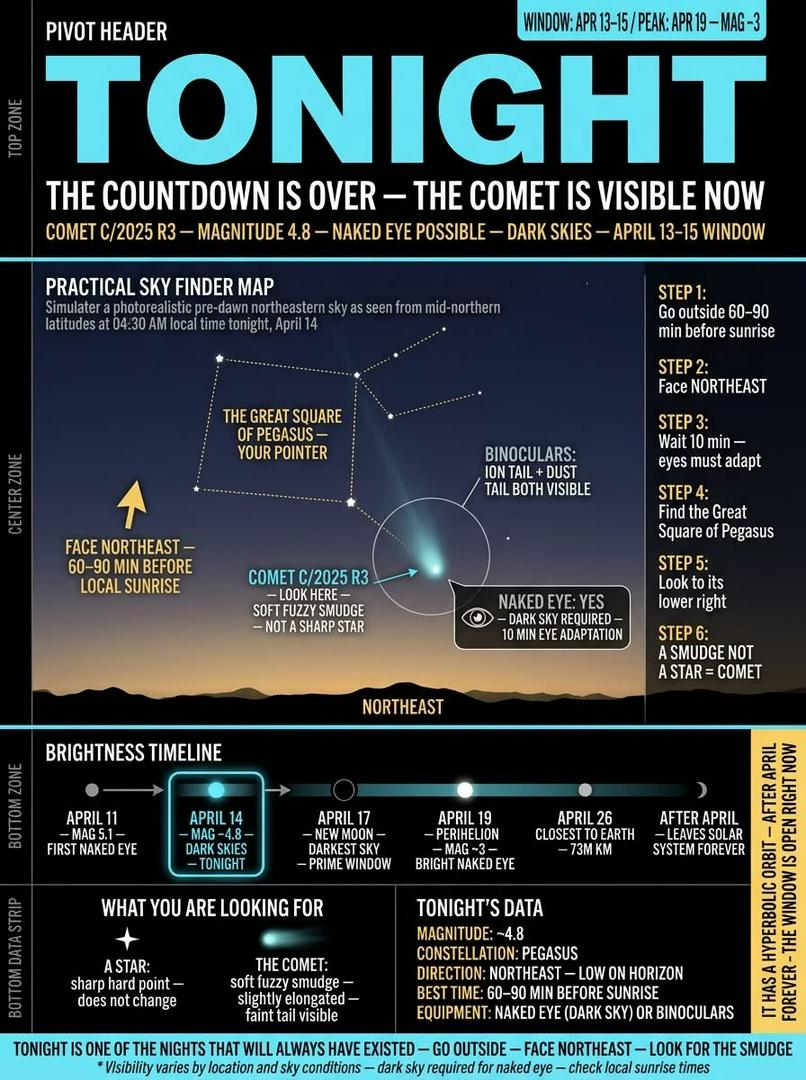
justme +FollowThe countdown is over. You can go outside and try to see it tonight. Comet C/2025 R3 PanSTARRS is now a naked-eye target in dark skies. Not in 6 days. Not in 4 days. Tonight. Here is exactly what to do. Go outside 60 to 90 minutes before your local sunrise. Face northeast. Let your eyes adapt to the darkness for at least 10 minutes — this is not optional. The comet is at magnitude 4.8 and sitting in the constellation Pegasus, just east of the Great Square — four stars forming a large square low in the pre-dawn northeastern sky. The Great Square is your pointer. Once you find it, look to its lower right. You are looking for something that does not look like a star. A star is a point. Sharp, hard, and perfectly still. This comet is a smudge. A soft, slightly elongated blur — brighter at the center and fading at the edges, with a faint tail extending northwest away from the Sun. It will not look dramatic from a city. From a dark field away from streetlights, binoculars will show it clearly — a distinct fuzzy object with a visible tail. The optimal naked-eye window is April 13 to 15. Tonight is inside that window. The New Moon on April 17 will darken the sky further. The peak comes at perihelion on April 19 when the comet is forecast to reach magnitude 3 — as bright as a moderately bright star. But the window where it is naked-eye accessible under good conditions — without needing peak brightness — is now. Tonight. What you need: dark sky, 10 minutes of eye adaptation, and the patience to look twice. If you see a soft glow that doesn't look quite like a star — you found it. It has a hyperbolic orbit. After April, it leaves the solar system forever. Tonight is one of the nights that will always have existed. Visibility varies by location — check local astronomical timings. #MoonlitEarth #CometC2025R3 #LookUpTonight #NakedEye #CometWatch #Astronomy #Comet202600Share