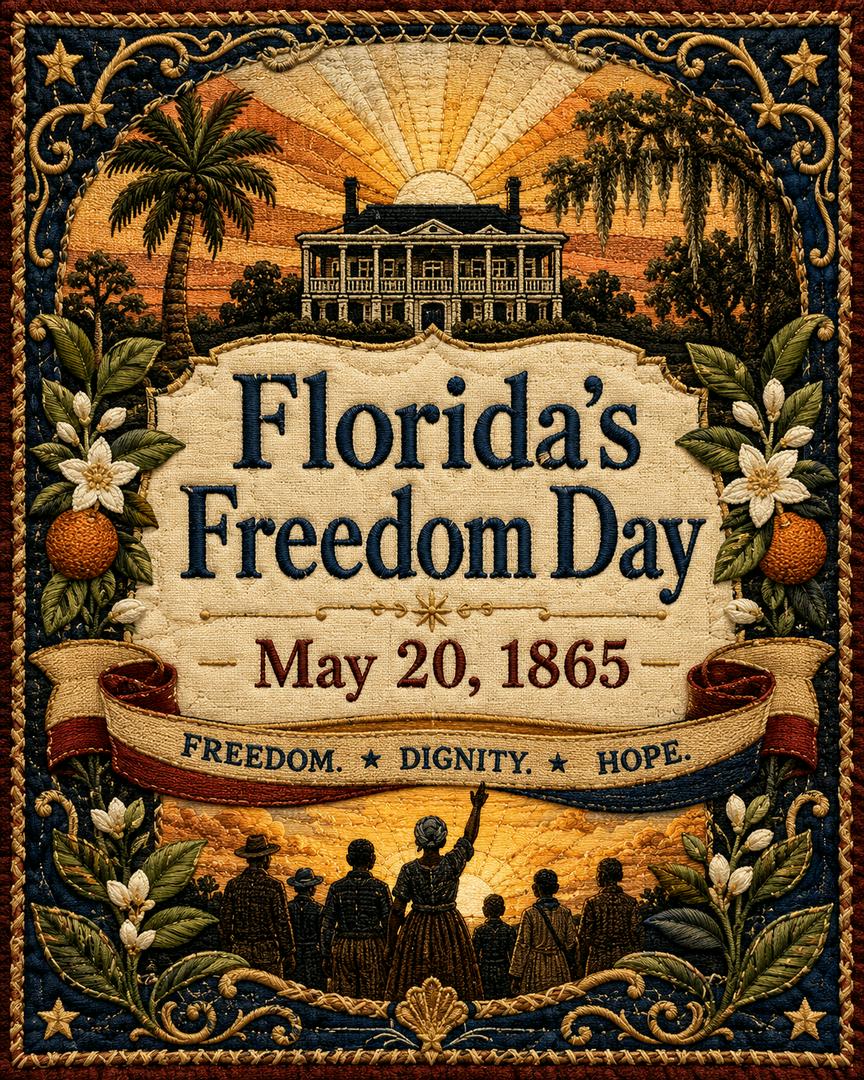
On May 20, 1865, freedom was publicly announced in Tallahassee, Florida. Union Brigadier General Edward M. McCook announced the Emancipation Proclamation from the steps of the Hagner House, now known as the Knott House.
That moment came more than two years after President Abraham Lincoln issued the Emancipation Proclamation on January 1, 1863.
That delay matters.
For many enslaved people in Florida, freedom did not arrive when it was written on paper. It arrived when Union authority reached the state capital and those words were finally backed by power.
By May 1865, the Civil War was ending, Confederate forces in Florida had surrendered, and Union control was being established. On May 20, McCook’s announcement declared the Emancipation Proclamation to be in effect in Florida’s capital.
That is why May 20 is remembered as Florida’s Emancipation Day.
This part of history reminds us that freedom in America did not arrive all at once. It came in different places at different times, shaped by war, distance, resistance, power, and delay.
Texas has Juneteenth. Florida has May 20. Other communities have their own freedom dates too.
Those dates do not compete with each other. They help complete the larger story.
Because emancipation was not one simple moment. It was a process. It had to be declared. It had to be heard. It had to be enforced. And even after that, it still had to be defended.
Florida’s Freedom Day matters because it shows how long people were forced to wait for a freedom that had already been promised.
And that is a history worth remembering.
#BlackHistory #AmericanHistory #FloridaHistory #EmancipationDay