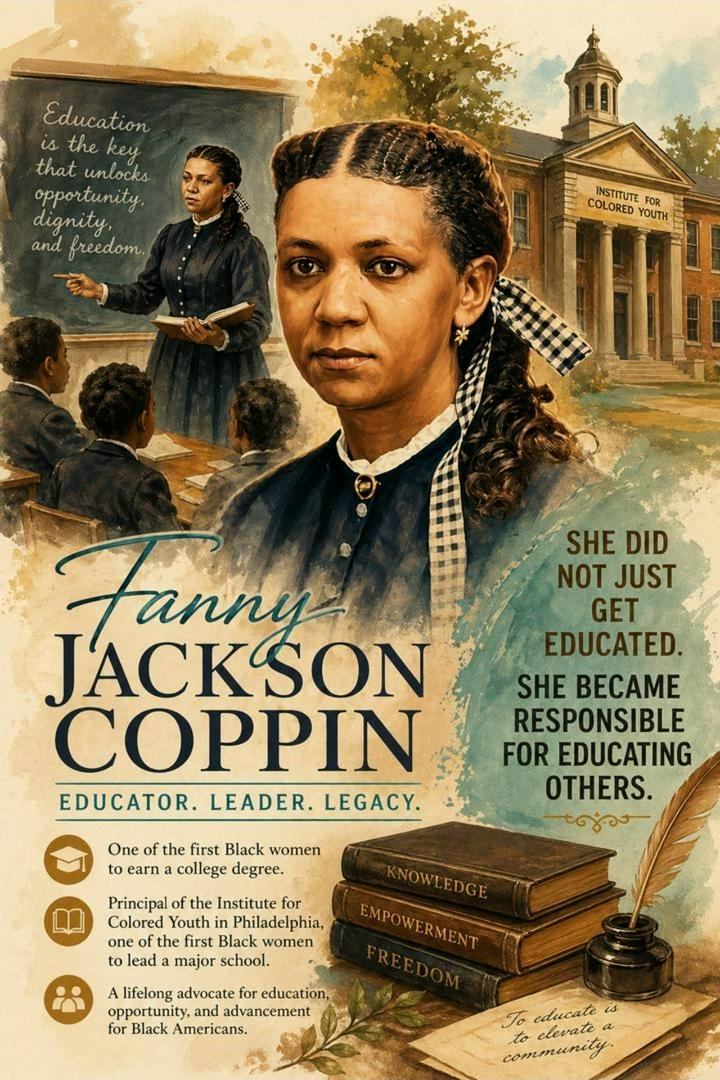
Fanny Jackson Coppin’s story is not just about getting an education. It is about what she did after education opened the door.
Born enslaved in Washington, D.C., in 1837, Coppin’s freedom was purchased by an aunt when she was still a child. She did not waste that freedom. She used it to build a life rooted in learning, leadership, and service.
Coppin attended Oberlin College in Ohio, one of the few schools at the time that admitted Black students and women. While there, she became the first Black student chosen for a student-teaching position. In 1865, she graduated with a bachelor’s degree, joining a small number of Black women in the 19th century who had earned a college education.
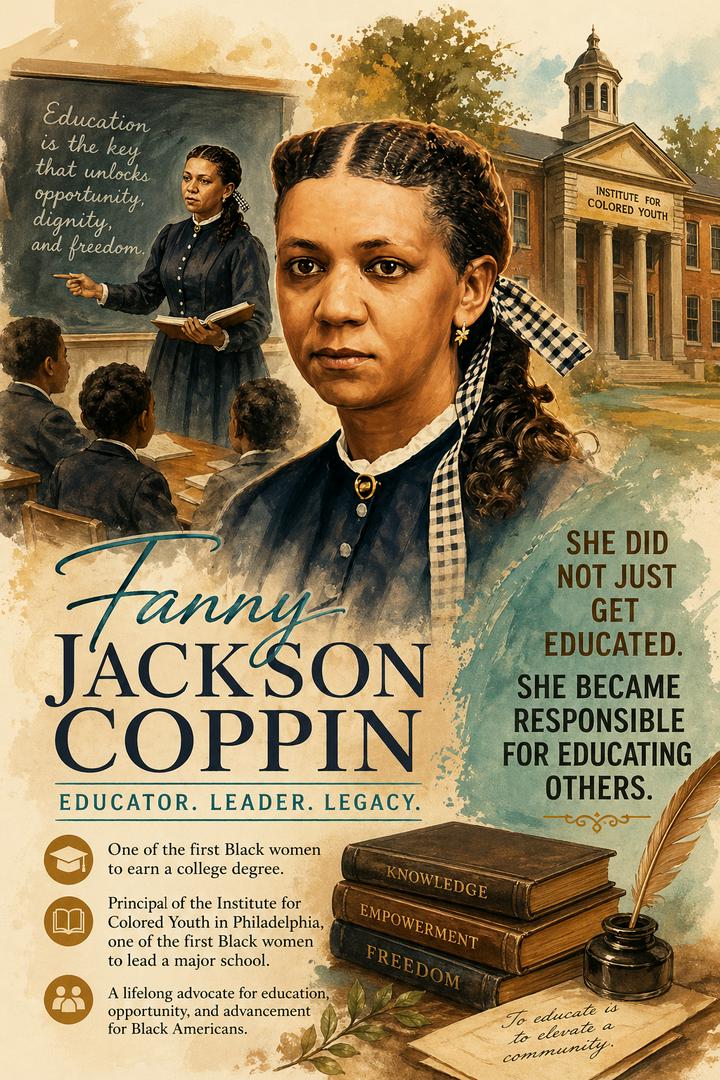
That same year, Coppin accepted a position at the Institute for Colored Youth in Philadelphia, a respected school created to educate Black students. She became principal of the Ladies’ Department and taught Greek, Latin, and mathematics. Within a few years, she became principal of the entire school.
That made her one of the first Black women in the nation to lead a major educational institution.
But Coppin’s work was bigger than a title. She believed education had to prepare students for real life. Under her leadership, the school focused on teacher training, strong academics, and industrial education, giving students both knowledge and practical skills.
She also fought for jobs, voting rights, and advancement for Black Americans at a time when talent did not guarantee opportunity. Coppin understood that education was not just about books. It was about survival, independence, and the ability to move through a world built with barriers.
Later, Coppin and her husband, Rev. Levi Jenkins Coppin, served as missionaries in South Africa, continuing her lifelong work in education and service.
Fanny Jackson Coppin deserves to be remembered because she did not simply rise through education. She turned around and used it to lift others.
That is legacy.
#FannyJacksonCoppin #BlackHistory