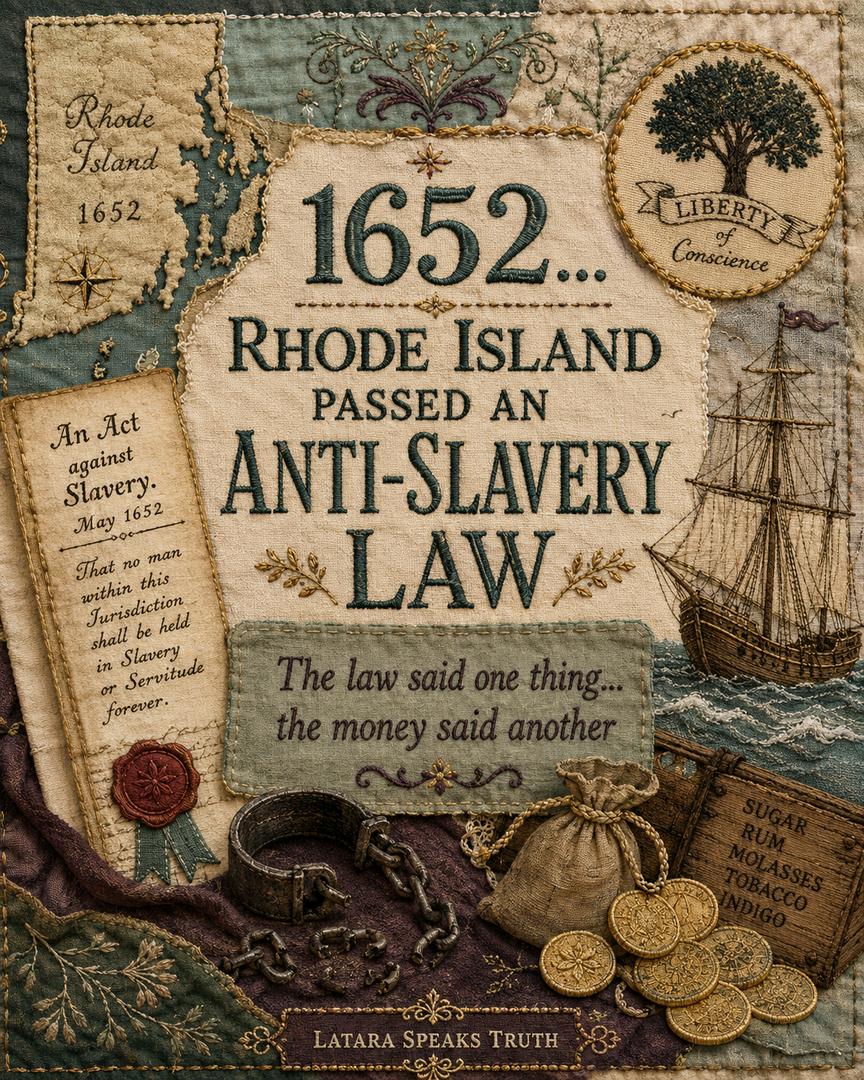
1652… Rhode Island Passed an Early Anti-Slavery Law, But Money Told a Different Story
On May 18, 1652, Rhode Island passed what is often considered the first anti-slavery statute in the English American colonies.
On paper, it sounded like a major step.
The law said that Black and white servants could not be forced to serve for life. It limited servitude to ten years, or until age 24 for those brought in as children. After that, they were supposed to be free, similar to English indentured servants.
But here is where history gets uncomfortable.
The law existed, but enforcement did not follow with the same energy.
That matters.
Because when a law says one thing, but money says another, people usually find out which one had the real power.
Rhode Island would later become deeply tied to slavery and the Atlantic slave trade, especially through ports like Newport. Ships, merchants, rum, labor, and profit became part of the colony’s economy. So while the 1652 law is remembered as an early anti-slavery statute, the reality after it shows how easily morality could be pushed aside when wealth was involved.
That is the contradiction.
Rhode Island could claim an early law against lifetime bondage while still becoming one of the colonies most connected to the business of human captivity.
This is why history cannot be read from laws alone.
A law can sound righteous.
A law can look progressive.
A law can be quoted later as proof that someone “tried.”
But if nobody enforces it, and if the economy keeps rewarding the opposite behavior, then the law becomes more like decoration than protection.
The painful truth is this: America’s early history is full of moments where the language of freedom was present, but the practice of freedom was selective.
And Rhode Island’s 1652 law is one of those moments.
The paper said one thing.
The profit said another.
#AmericanHistory #BlackHistory #RhodeIslandHistory #HiddenHistory #HistoryMatters