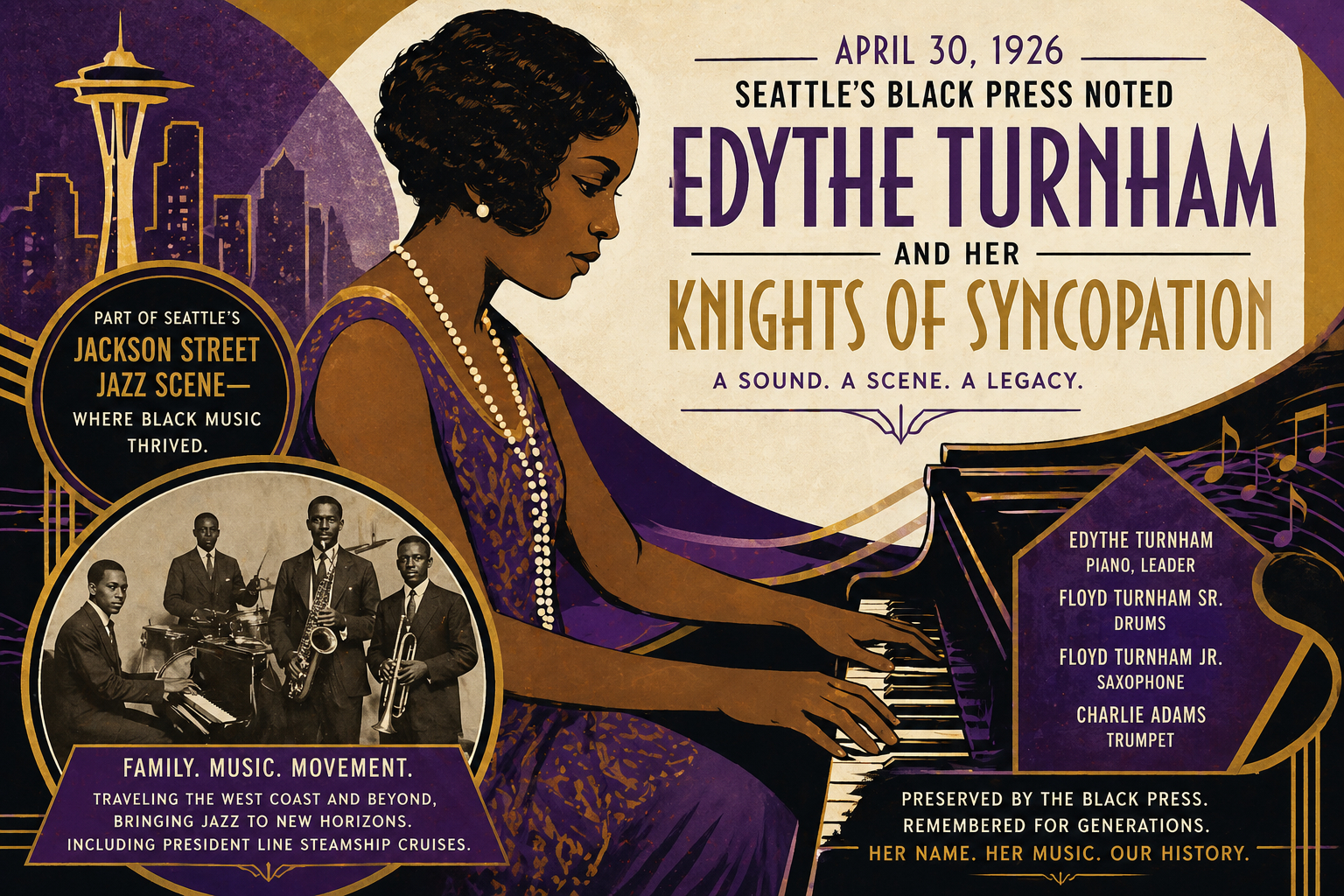
On April 30, 1926, Seattle’s Black press noted Edythe Turnham’s Knights of Syncopation, a jazz group tied to the city’s early music scene.
Edythe Turnham was a pianist, bandleader, and one of the women helping shape jazz in the Pacific Northwest during the 1920s. Born Edythe Pane in Topeka, Kansas, she began playing piano as a young child before moving to Spokane, Washington, around 1900. Over time, she became part of a traveling performance tradition that carried music through Washington, the West Coast, and beyond.
By the early 1920s, Turnham had organized a small band that became known as Edythe Turnham and Her Knights of Syncopation. The group included members of her own family, including Floyd Turnham Sr. on drums and Floyd Turnham Jr. on saxophone. Charlie Adams was also listed as a trumpeter connected to the band.
Their music was part of a larger jazz world growing around Seattle, especially around Jackson Street, where Black musicians helped build one of the city’s most important cultural scenes. Turnham’s group played along the West Coast and performed on President Line steamship cruises, showing how Seattle musicians were not isolated. They were moving, traveling, performing, and carrying their sound into wider spaces.
The mention in the Northwest Enterprise matters because Black newspapers helped preserve stories that larger outlets often ignored. Without papers like that, many musicians, performers, and community figures might have disappeared from the public record.
Edythe Turnham’s story is not as widely known as many jazz legends from New Orleans, Chicago, or Harlem, but her place in Seattle’s early jazz history is real. She was a woman leading musicians during a time when both race and gender created barriers. Her name belongs in the record because she was part of the sound, movement, and memory of Black music in the Pacific Northwest.
#BlackHistory #MusicHistory #JazzHistory #SeattleHistory #HiddenHistory