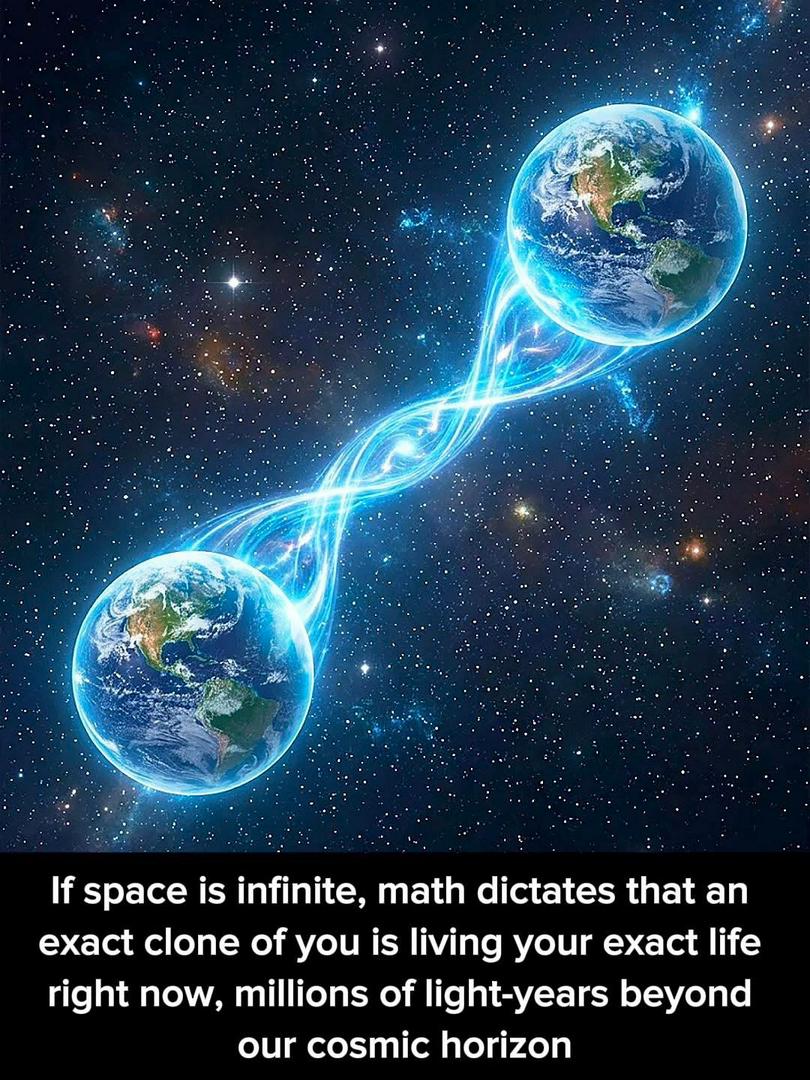
justme +FollowThere Is an Exact Copy of You Reading This Right Now : We usually think of the universe as a bubble holding everything we know. But the "Level 1 Multiverse" theory completely shatters that comfort zone. Here is the undeniable mathematical truth: if space goes on forever, the arrangement of atoms and particles must eventually repeat itself, because there are only so many ways matter can be organized (Tegmark, 2004). This means that far beyond the 46 billion light-years of our observable universe, there is another Earth. On that Earth, there is another you, sitting exactly where you are, reading this exact sentence at this exact second. There are infinite versions of you who made the exact same choices, and infinite versions who made slightly different ones. You are not alone; your life is playing out on a cosmic loop forever. The next time you look up at the night sky, realize that somewhere out there, someone with your face is looking right back #facts #nasa #Galaxy #universe #fblifestyle00Share
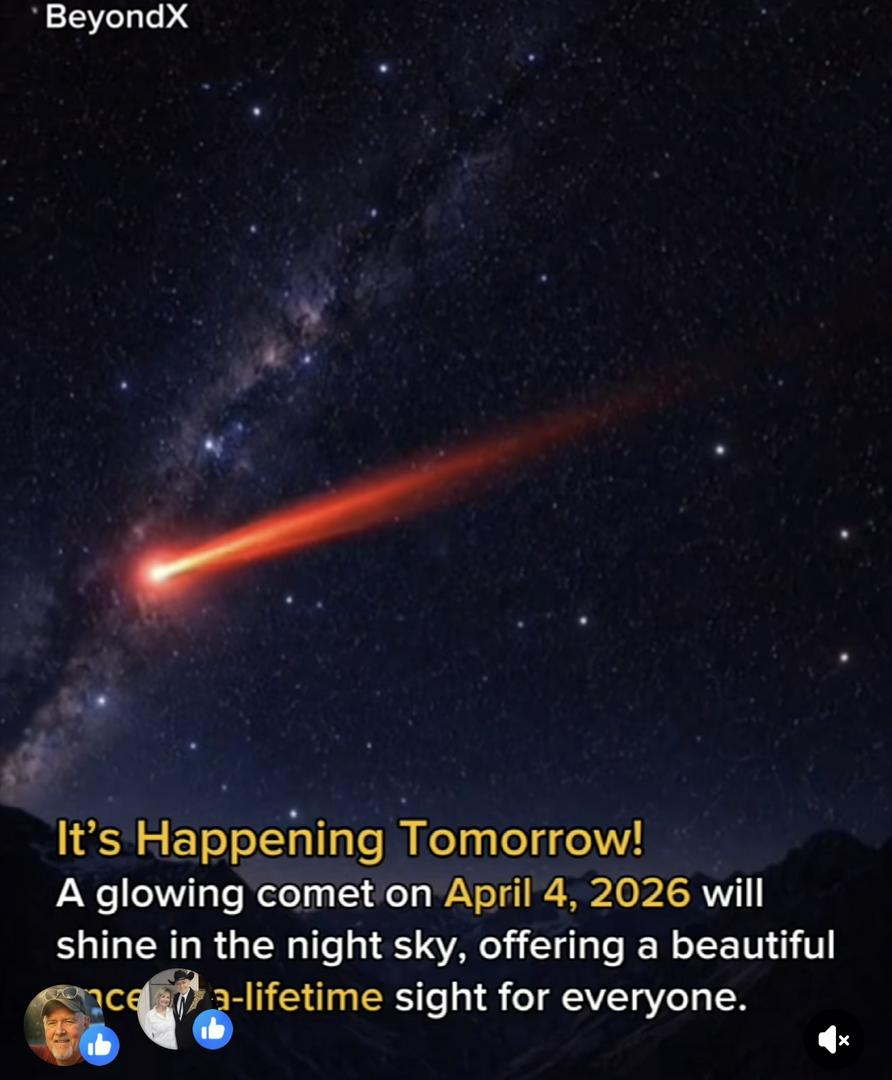
justme +FollowIt’s Happening Tomorrow! A glowing comet on April 4, 2026 will shine in the night sky, offering a beautiful once-in-a-lifetime sight for everyone. #space #science #fact #facts190Share
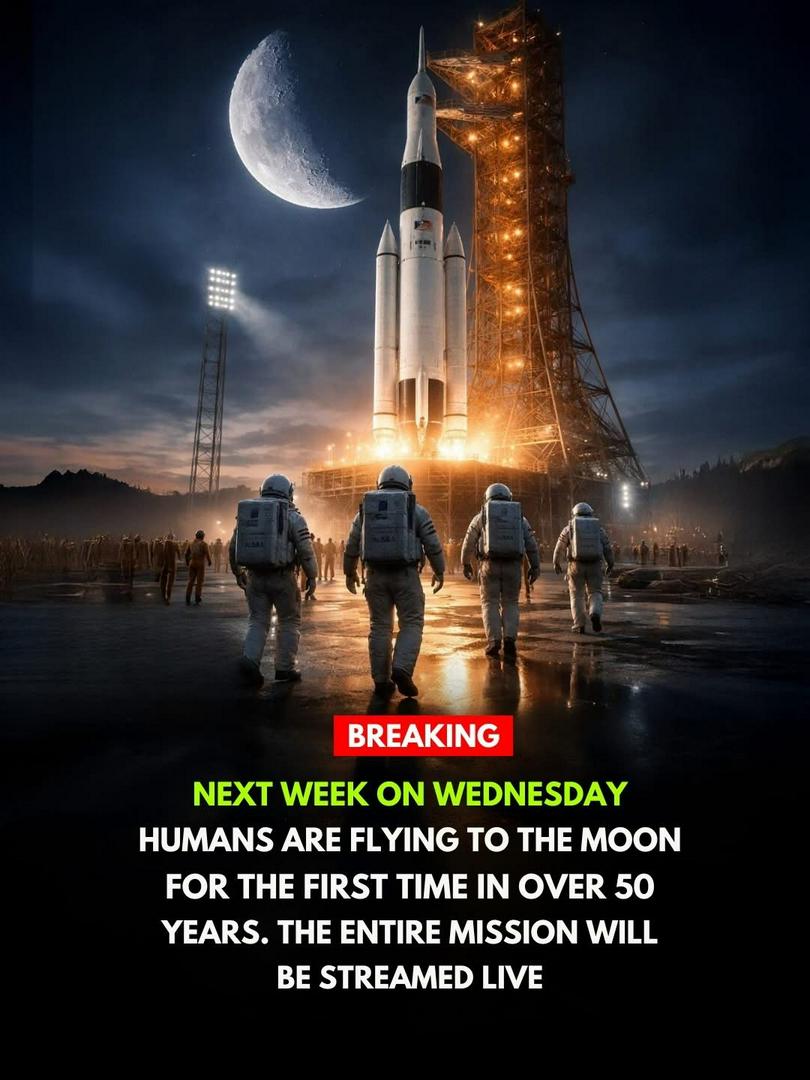
justme +FollowThe last time humans ventured beyond Earth orbit was December 1972. Apollo 17. Gene Cernan and Harrison Schmitt walked on the lunar surface. Then they climbed back into their spacecraft, lifted off, and left. And for 54 years — no human being went back. That changes in six days. Artemis II will carry four astronauts on a 10-day journey around the Moon and back to Earth. Not a landing. Not yet. But a free-return trajectory that will carry them farther from Earth than any human being has traveled since the final Apollo mission — swinging them around the far side of the Moon before gravity pulls them back home. The crew: Reid Wiseman — Commander. A Navy test pilot and veteran astronaut who has already spent 167 days aboard the International Space Station. Victor Glover — Pilot. A Navy aviator and NASA astronaut who will become the first person of color to travel beyond Earth orbit. Christina Koch — Mission Specialist. A NASA astronaut who holds the record for the longest single spaceflight by a woman, spending 328 consecutive days in space. Jeremy Hansen — Mission Specialist. A Canadian Space Agency astronaut and former Royal Canadian Air Force fighter pilot. This will be his first spaceflight — and he will become the first Canadian to leave Earth orbit. Four people. Four firsts. One mission. They won't land on the Moon. But they will do something that hasn't happened in over half a century: they will see it up close, with their own eyes, through a window, from a spacecraft they are flying themselves. They will watch it fill the entire frame as they swing around its far side — a view so rare that only 24 human beings in history have ever experienced it. All of them in the 1960s and 70s. The entire mission will be streamed live by NASA. Every burn. Every maneuver. Every moment the crew looks out that window at a Moon that suddenly isn't a dot in the sky anymore — it's a world, and they're next to it. The launch window opens April 1 at 4:20 UTC. Six days from now. We are31Share
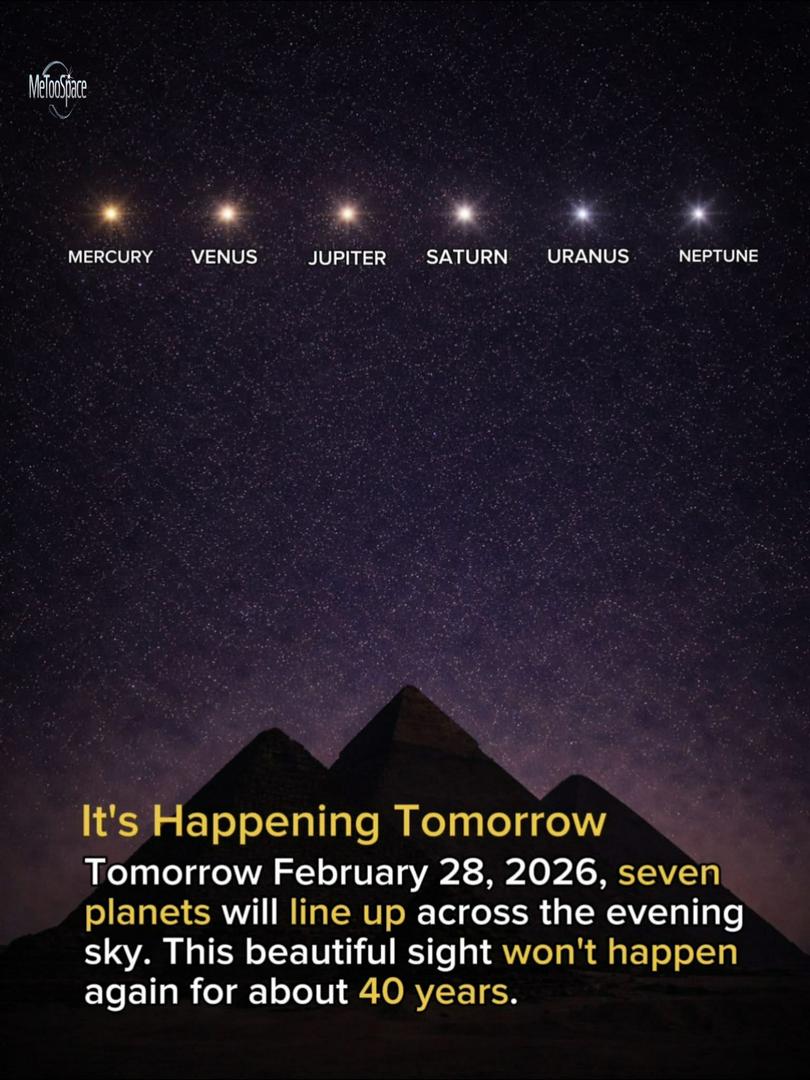
justme +FollowDon't Miss Tomorrow On February 28, 2026, a rare sky event will take place. Seven planets Mercury, Venus, Jupiter, Saturn, Uranus, and Neptune (along with Mars) will appear lined up across the evening sky. Just after sunset, you’ll be able to see several of them shining like bright stars. Some planets will be easy to spot with your eyes, while others may need binoculars or a small telescope. This kind of planetary alignment does not happen often. It will be many years before we see a similar lineup again. If the sky is clear, step outside shortly after sunset and enjoy this beautiful and special moment in the night sky. #space #science #fact #facts50Share
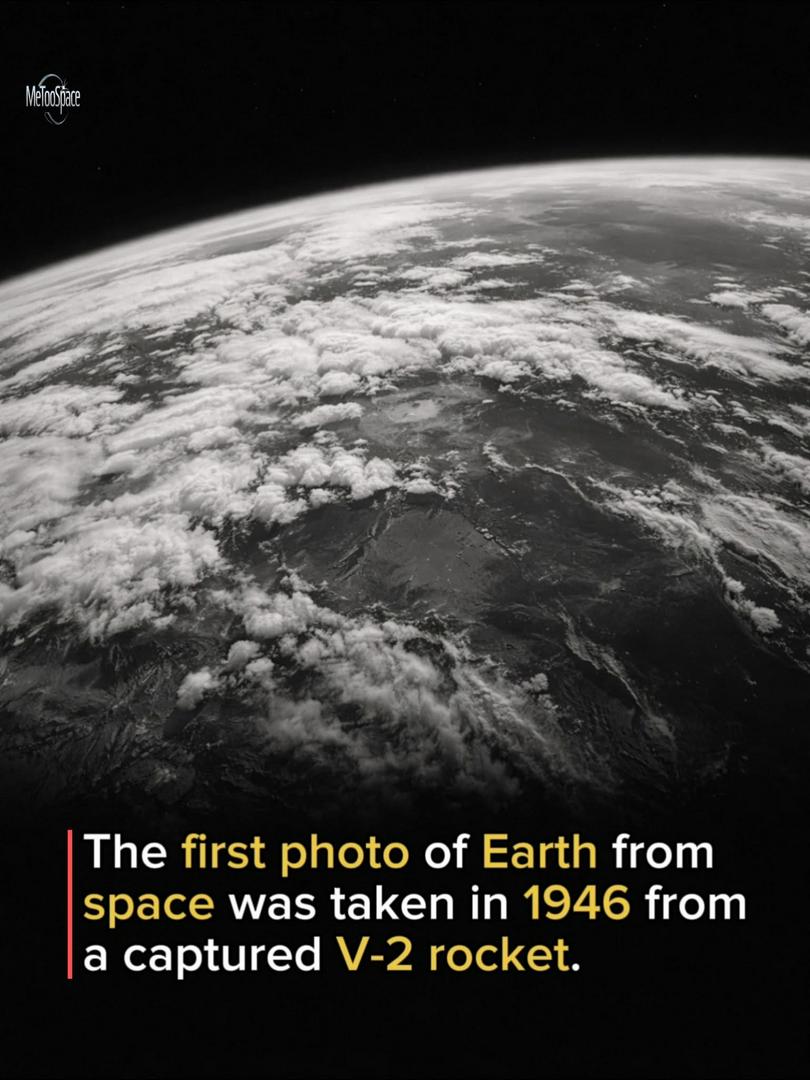
justme +FollowFirst Photo of Earth From Space (1946) The first photograph of Earth from space was taken on October 24, 1946, using a captured German V-2 rocket launched by the United States from White Sands Missile Range in New Mexico. After World War II, American scientists used these rockets for research. They attached a small 35mm motion picture camera to the rocket, which automatically took pictures as it rose to an altitude of about 105 kilometers (65 miles) above Earth. From that height, the camera captured a stunning black-and-white image showing the curve of our planet against the darkness of space. This was the first time humans had ever seen Earth from beyond the atmosphere. Although the rocket later crashed back to the ground, the film survived inside a protective steel container. This historic moment marked the beginning of space photography and opened the door to future missions, satellites, and eventually astronauts traveling into space. It was a small step toward the space age but a giant leap in how humanity viewed its home planet. #space #science #fact #facts30Share
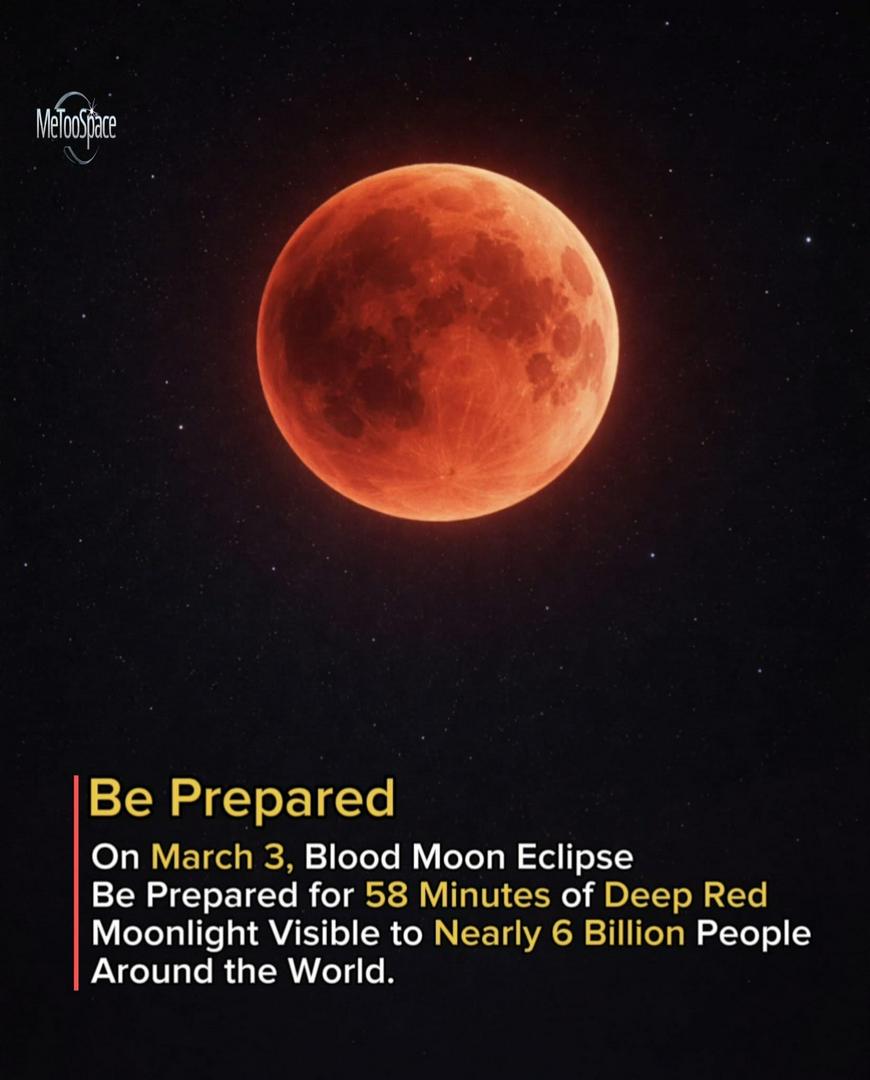
justme +Follow🌕 March 3 Blood Moon Eclipse: Be Prepared for 58 Minutes of Deep Red Moonlight On March 3, skywatchers around the world will witness a breathtaking Blood Moon eclipse, as the Moon turns a deep red color for about 58 minutes during totality. This happens during a total lunar eclipse when the Earth moves directly between the Sun and the Moon, casting a shadow that filters sunlight and gives the Moon its dramatic red glow. Nearly 6 billion people across different continents will have a chance to see this rare event with the naked eye, weather permitting. No special equipment is needed just look up at the night sky at the right time. It’s a perfect moment to gather with family, take photos and experience one of nature’s most beautiful celestial events. Don’t forget to check your local timing and be prepared to enjoy this unforgettable red Moon spectacle! #space #science #fact #facts301Share
maven+FollowYou don’t need more confidence. You need fewer contradictions between your words and your actions! #love #truth #healing #benefits #daily #news #date #today #yesterday #everyday #lifestyle #life #laugh #smile #weekend #sunday #Philosophy #truth #facts #fyp121Share
justme +FollowIn 1948, inside a San Diego hospital ward filled with children suffering from the terrifying polio epidemic, a recovering schoolteacher named Eleanor Abbott invented a way for them to escape. Surrounded by iron lungs and restricted movement, Abbott sketched out a colorful world where paralyzed kids could freely travel without needing to read or use strategy, giving them a psychological lifeline during their darkest days. #history #facts #education #knowledge #survival #historic #didyouknow #factsdaily #historyfacts #old #heritage #educational #historylovers15225Share
justme +FollowBorn weighing 13.5 pounds and presumed dead, he became one of the greatest voices in history. #history #facts #franksinatra #newjersey1528Share