1/1
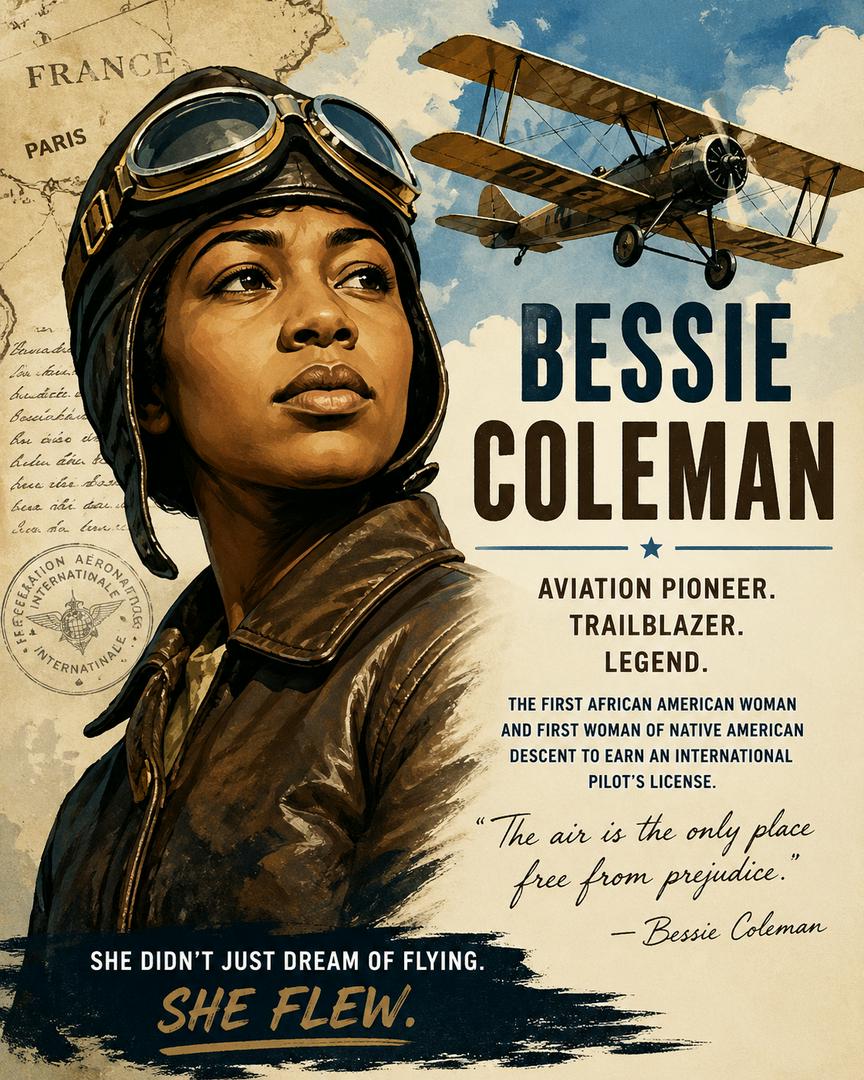
April 30, 1926, marked the tragic death of aviation pioneer Bessie Coleman, a woman who rose above poverty, racism, and sexism to make history in the sky. Coleman was born in Texas in 1892 and grew up during a time when Black Americans faced brutal segregation and limited opportunity. When she became interested in flying, American flight schools refused to train her because she was Black and a woman. Coleman did not quit. She learned French, saved money, gained support from Black leaders in Chicago, and traveled to France to chase the dream America tried to deny her. In June 1921, Coleman earned an international pilot’s license from the Fédération Aéronautique Internationale. She became the first African American woman and the first woman of Native American descent to hold a pilot’s license. Her achievement made her a symbol of courage and possibility. Known as “Queen Bess,” Coleman returned to the United States and became a barnstorming pilot, performing daring air shows before large crowds. She also used her fame to encourage other Black Americans to enter aviation. She refused to perform at venues that would not admit Black spectators, making her stand for dignity both in the air and on the ground. On April 30, 1926, Coleman was in Jacksonville, Florida, preparing for an air show scheduled for the next day. She was flying with mechanic William Wills when the plane suddenly went out of control. Coleman, who was not wearing a seat belt because she was looking over the side to scout the area, fell from the aircraft and died. Wills also died when the plane crashed. Bessie Coleman was only 34 years old. Her life ended in tragedy, but her legacy did not. She opened a path in aviation when the doors were locked, bolted, and guarded. Generations of pilots would later look to her as proof that the sky belonged to them, too. #BessieColeman #BlackHistory #AviationHistory #WomensHistory #OnThisDay
2026-04-30

James Alston Jr
I've never heard her story very interesting 🧐 1st African American woman in the sky
29d
Statesboro, GA
Reply
2

Diann Lewis
Thank You for letting us know about this beautiful Queen. 🥰🥰🥰🥰🥰🥰👍👍👍👍🙏🙏🙏💕💕💕💕💕
29d
Stockton, CA
Reply
2

Jan Ferra
🥰🥰🥰
29d
Walled Lake, MI
Reply
2

Brandon Lopez
yzh za
27d
Lancaster, PA
Reply
More comments ...
write a comment...