1/1

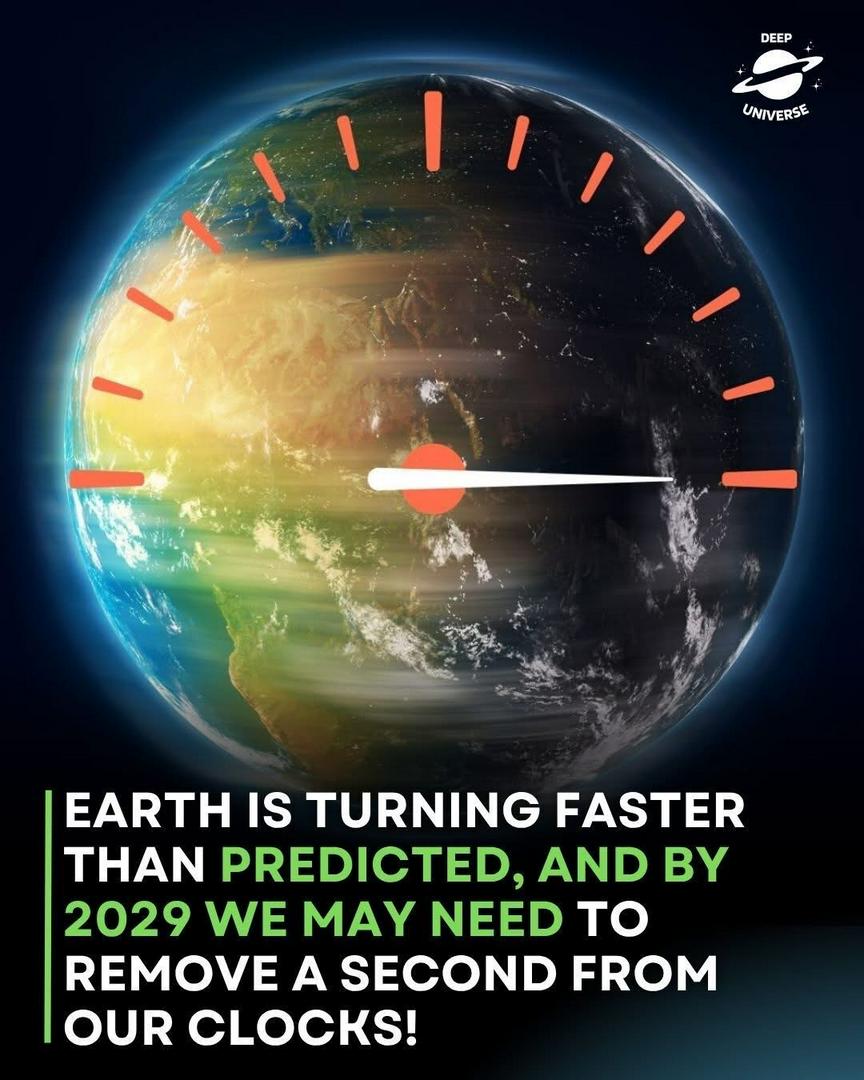
Scientists have discovered that Earth has recently been spinning slightly faster than expected, raising the possibility that the world may eventually need to remove a second from official time for the first time in recorded history. For decades, Earth's rotation has generally been slowing due to gravitational interactions with the Moon. That gradual slowdown is why leap seconds were introduced in 1972 to keep atomic clocks aligned with Earth's actual rotation. However, since 2020, researchers have recorded several unusually short days. On some occasions, Earth completed a rotation milliseconds faster than the standard 86,400 second day, attracting attention from timekeeping organizations around the world. The difference is tiny and impossible for people to notice in daily life, but modern technology depends on extraordinary precision. Global positioning systems, financial networks, telecommunications, and scientific instruments rely on atomic clocks that measure time with incredible accuracy. Scientists believe changes within Earth's core, shifts in the atmosphere, ocean circulation, and long term climate processes may all contribute to these subtle variations in planetary rotation. One surprising insight is that a change of just a few milliseconds can become important when accumulated over years. Researchers monitoring Earth's rotation have suggested that if current trends continue, a negative leap second, meaning one second removed rather than added, could be required sometime around 2029. No negative leap second has ever been implemented before, making it a unique challenge for global timekeeping systems. #deepuniverse #earth #science #timekeeping #universe #cosmos #spacefacts #fblifestyle
1 days ago
write a comment...