1/1

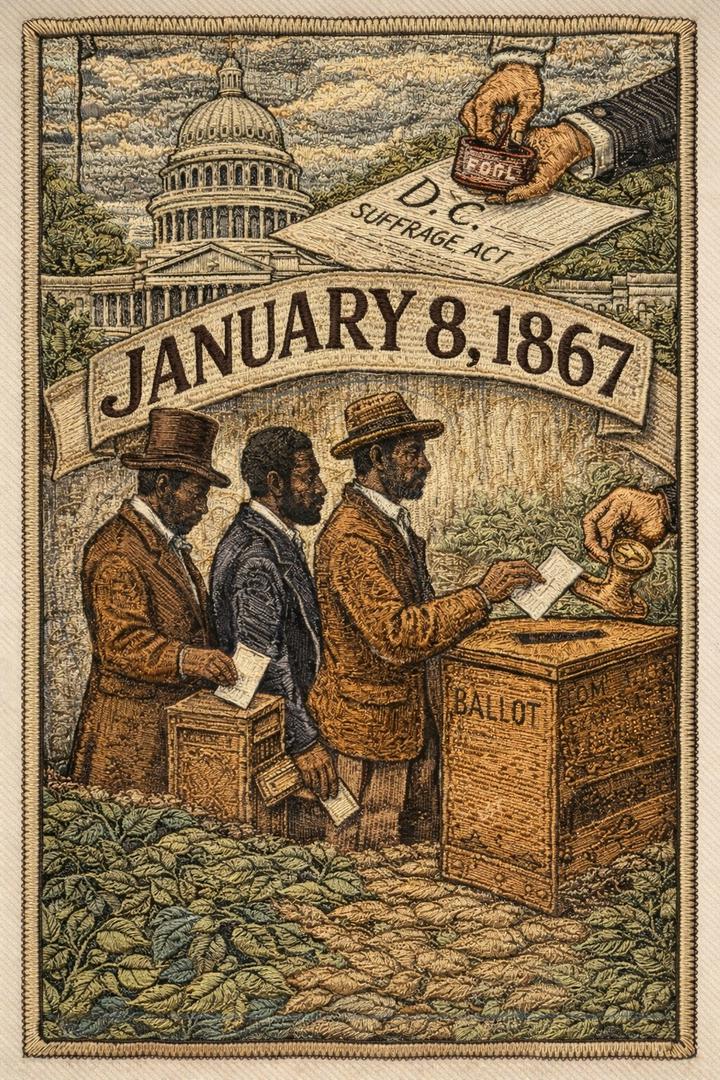
January 8, 1867 marks a turning point in American history that is rarely given the attention it deserves. On this day, Congress passed the District of Columbia Suffrage Act, granting Black men in Washington, D.C. the legal right to vote in municipal elections and public referenda. This happened three years before the 15th Amendment, at a time when most of the nation still viewed Black political participation as a danger rather than a right. This was not a promise for the future or a symbolic gesture. It was an immediate, enforceable change written directly into law. The decision did not come quietly or without resistance. President Andrew Johnson vetoed the act, arguing that extending voting rights to Black men was premature and would destabilize the country. Congress rejected that argument and overrode his veto the same day. That override mattered. It made clear that Reconstruction was not only about ending slavery on paper but about redistributing political power in real time. Washington, D.C. became a proving ground, showing that Black civic participation could exist and function despite fierce opposition. The importance of January 8, 1867 is often overlooked because it does not fit neatly into the simplified version of history many are taught. Voting rights did not suddenly appear with the 15th Amendment. They were demanded, tested, expanded, restricted, and attacked repeatedly. This moment captures Black men exercising political agency while the nation was still debating whether they deserved it. It reminds us that progress has never required national comfort or unanimous approval. Rights have always moved forward through pressure, confrontation, and refusal to wait. January 8 stands as proof that access was forced open long before the country was ready to admit it. #January8 #OnThisDay #BlackHistory #ReconstructionEra #VotingRights #DistrictOfColumbia #AmericanHistory #HiddenHistory #CivilRights
Washington, District Of Columbia • 2026-01-08

Dorothy Johnson
I knew about black elected officials from that era, but I don't remember reading about this. I have to do some research. At this crucial time in history, with some black people feeling so helpless and hopeless, we need something to give them hope, especially our young people. Those of us who have been around a while must do better in that regard. I get a lot of criticism for reminding people that we need to do better... each one, teach one.
01-08
Chicago, IL
Reply(14)
18

James Bennett
Voting today is still a hotly contested issue. The one place Americans want to see “fair” written into law is in their elections
01-11
Spokane, WA
Reply(19)
10

SIRMRBALL
They know all the things done to blk folks and as wrong so they try to say republicans help us but they didn’t! We made all this possible for ourselves! If the republicans help blk folks so much why yall still racist🤔
01-11
Virginia Beach, VA
Reply(5)
5
inquiring minds
very informative great article 👍
01-10
Brooklyn, NY
Reply
5

Sequoyah Taylor
he's trying to take everything away literally
01-10
Detroit, MI
Reply
5

Lashell Young
❤️❤️❤️👏🏾👏🏾
01-08
Plainville, KS
Reply
5

Prophet Elijah
My great grandfather had his 40acres and two oxen’s getting busy farming and logging. I am named after him and got his 40acres with One oxen 🤔🤔voting wasn’t the problem…….
03-07
Little Rock, AR
Reply(3)
3

Paula OConnor
Thanks. Didn't know about this.
01-09
Philadelphia, PA
Reply
4

Guest
We need Reparations written into law
01-14
Reply(2)
2

Michele King
👍 Good Day Everyone Should Be Treated With Respect No Matter Their Color Still People And You Don't Have Any Control Of How You Come In To It Ignorant People 😔👎🇱🇷👎 You Will Answer To Our God One Day 🙏❤️😊
01-12
Jackson, MI
Reply
3
More comments ...
write a comment...